What Does “Made in Europe” Really Mean in Clothing?
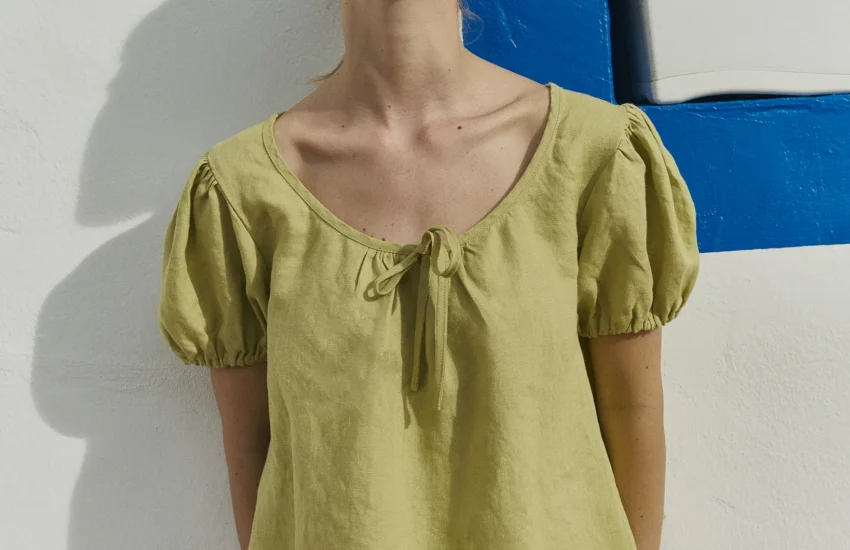
Picture from Manufacture de Lin – an Ukrainian company making linen clothing from European linen.
You see the label. You feel reassured. But what does “Made in Europe” actually tell you when it comes to clothing — and what does it leave out?
The honest answer is that it usually points to just one step in a much longer journey: layer 3 in the clothing production chain — garment assembly. That means the cutting and sewing of the final garment happened in Europe. Not necessarily the fabric. Not the fibre. Not the spinning or dyeing. Just the last stitching together.
A Chain of Eight Layers
Think of clothing production not as one act, but as eight distinct layers: raw materials, fabric production, garment assembly, design, branding, distribution, aftersales and recycling. Europe’s position in each of these is very different.
| Layer | Europe’s position |
| 1. Raw materials | Minor player |
| 2. Fabric production | Strong in technical textiles |
| 3. Garment assembly | Largely outsourced to Asia |
| 4. Design expertise | Global leader |
| 5. Branding | Dominant luxury powerhouse |
| 6. Distribution | Well-developed, omnichannel |
| 7. Aftersales | Growing, still nascent |
| 8. Recycling | Frontrunner, heavy investment |
When a brand says “Made in Europe”, it usually refers to layer 3 — the one with the lowest margins and the one most commonly outsourced.
One Journey, Many Countries
Take Mud Jeans as a concrete example. Top quality jeans that you can even hire instead of buying it. Design and branding happen in the Netherlands. The organic cotton comes from Turkey. Fabric production and dyeing happen in Spain. Assembly happens in Tunisia. That is actually a short chain compared to many mass-market brands — and yet none of it is fully European.
By the time a garment hangs in your wardrobe, it has often quietly travelled more than most people do in a year.
When a Brand Goes Further
Some brands go well beyond layer 3. Manufacture de Lin, which you can find on InEurope, works with linen woven from 100% European flax in a long-established European linen mill. That is a fundamentally different claim — one that reaches back into layer 2 (fabric production) and even layer 1 (raw materials). That story deserves to be told differently than a simple “Made in Europe” label.
The Better Question to Ask
So the next time you see that label, ask a few more questions. Where was the fabric woven? Where did the fibre come from? Was it dyed in Europe? Was the yarn spun here?
A brand that can answer those questions clearly — and honestly — is telling you something much more meaningful than a country of final assembly.
InEurope focusses on Layer 3 – the assembly. Also called “bad jobs” in ‘The Smile Curve) by Richard Baldwin.