
Ventile and etaProof: How Cotton Became a Weatherproof Fabric
Two names, a shared textile heritage, and an unusual way of keeping the rain out.
Ventile and etaProof are closely related weather-resistant fabrics, best known for their exceptionally dense cotton weave. Since 1998, their classic versions have used the same base fabrics, although today’s product ranges are no longer necessarily identical.
Unlike conventional waterproof laminates, classic Ventile relies on the structure of cotton itself. When the fibres absorb moisture, they swell, making an already tightly woven fabric even more resistant to water penetration.
The idea has roots in British textile innovation stretching back more than a century.
How does Ventile work?
Ordinary cotton is not particularly good at keeping rain out. It absorbs water, becomes wet and can take a long time to dry.
Ventile turns one of these apparent disadvantages into a useful property.
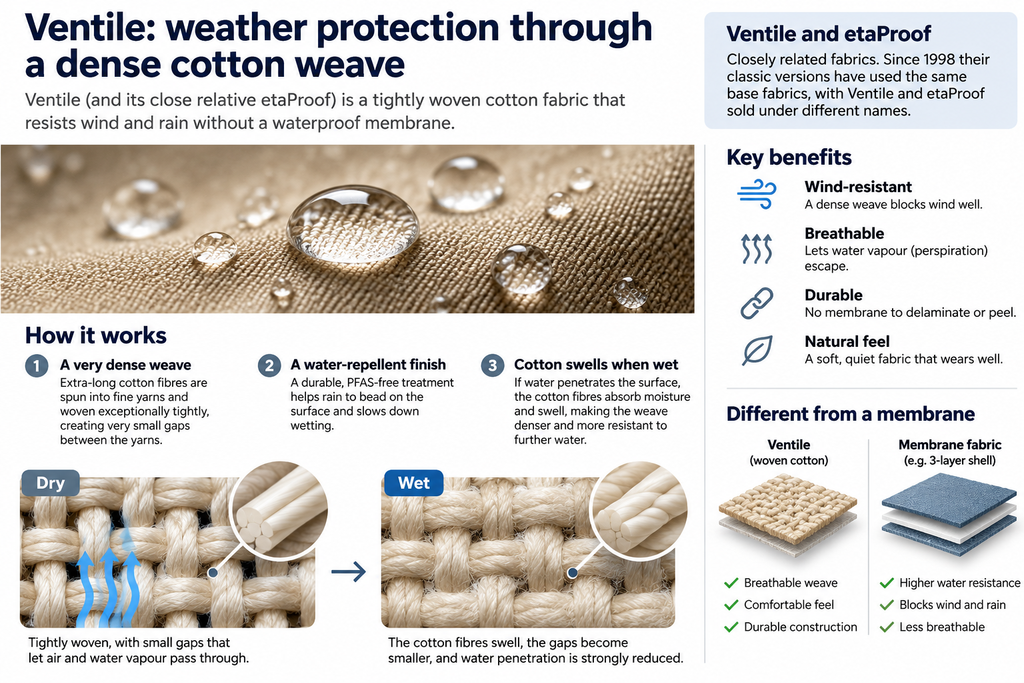
The classic fabric is made from carefully selected extra-long-staple cotton, spun into fine, uniform yarns and woven exceptionally tightly. Even when dry, the spaces between the yarns are very small, providing effective protection against wind.
When rain reaches the fabric, two mechanisms come into play.
First, a water-repellent finish helps droplets roll off the surface. If water eventually penetrates this treatment, the cotton fibres begin absorbing moisture and swelling. This reduces the spaces within the weave, making it more difficult for further water to pass through.
The fabric becomes denser as it gets wet.
Importantly, classic Ventile needs no waterproof membrane or impermeable coating. Water vapour can pass through its woven structure, helping moisture escape from inside a garment.
The result is a fabric that offers an unusual combination of wind resistance, rain protection, breathability and a relatively soft, quiet feel.
The story began before Ventile
The idea of weather-resistant, breathable cotton did not originate during the Second World War.
In 1922, British doctor and explorer Sir Wilfred Grenfell spoke in Burnley, Lancashire, about the difficulties of finding suitable clothing for his work in Labrador, Canada.
His requirements were straightforward but demanding. Clothing needed to resist wind, rain and snow while allowing perspiration to escape.
Among the audience was Walter Haythornthwaite, whose family operated a local weaving mill.
Inspired by the challenge, Haythornthwaite developed a tightly woven cotton fabric that became known as Grenfell Cloth in 1923.
It proved useful in harsh northern conditions and subsequently found applications in aviation, mountaineering and outdoor clothing.
Grenfell Cloth was not Ventile, but it demonstrated that densely woven cotton could provide serious weather protection without relying on an impermeable rubber coating.
From British research to RAF clothing
Ventile emerged from a different development programme at the Shirley Institute in Manchester, a centre for British cotton research.
Development began in the late 1930s, and the fabric became associated with the urgent demands of the Second World War.
British aircrew operating over cold northern waters faced a difficult problem. Their clothing needed to remain comfortable during long flights but also provide protection if they were forced into the sea.
Conventional waterproof materials could offer protection against water while being uncomfortable during normal activity. The Shirley Institute pursued a fabric that could combine weather resistance with greater comfort.
1943 is generally recognised as Ventile’s founding year.
The fabric became closely associated with RAF survival clothing, although some details of the popular wartime story deserve caution.
A historical account published by the Royal Air Force Historical Society dates the introduction of the RAF’s two-piece Ventile immersion suit to 1951. This does not rule out earlier applications, but it makes widely repeated claims about wartime survival rates difficult to establish independently.
Ventile subsequently found a place in demanding outdoor environments. It is associated with the successful 1953 Everest expedition and later polar exploration.
A textile developed for specialist protective clothing had become part of outdoor history.
Why two names: Ventile and etaProof?
For decades, Ventile was associated with British textile manufacturing, including Talbot Weaving.
As production arrangements changed, the Swiss textile specialist Stotz & Co. became increasingly involved in manufacturing and finishing the fabric.
Stotz also developed its own brand, etaProof, aimed at applications beyond Ventile’s traditional markets.
The relationship eventually became remarkably close.
According to specialist fabric distributor Extremtextil, Ventile and etaProof have used the same base fabrics since 1998. In 2017, Stotz acquired the Ventile brand rights, bringing both names under the same company.
For many classic cotton grades, the difference was therefore largely one of branding rather than a fundamentally different textile technology.
However, the names should not automatically be treated as interchangeable today. Fabric weights, constructions, finishes and newer material compositions can differ.
Waterproof or comfortable?
Ventile raises an interesting question: does an outdoor jacket need to be completely waterproof, or does it need to keep its wearer comfortable?
These are not always the same thing.
A membrane jacket may withstand much greater water pressure, making it better suited to prolonged heavy rain. But waterproof performance alone says little about ventilation, perspiration, noise or comfort during physical activity.
Ventile takes a different approach, prioritising a balance between weather protection and breathability.
It has limitations. During prolonged rain, water can eventually penetrate the fabric, particularly under pressure from backpack straps or at seams. Wet cotton also becomes heavier and dries more slowly.
Yet the classic construction offers an important durability advantage: there is no waterproof membrane that can delaminate. The dense weave remains part of the fabric throughout its life.
This does not make Ventile maintenance-free. Its water-repellent finish can deteriorate, and the fabric itself can wear out.
The more useful distinction may be between a fabric designed to resist the greatest possible water pressure and one designed to maintain a comfortable balance across changing conditions.
Ventile today: British origins, Japanese ownership
Ventile’s ownership changed again in May 2025, when the Japanese textile company MN Inter-Fashion Ltd. acquired the trademark rights through an agreement involving Stotz & Co. and Daiwabo Spinning.
The existing European production and sales operations were retained through a partnership with Germany’s Weichert GmbH.
Modern Ventile has also moved beyond its original cotton specification. Alongside Ventile Classic, the brand now explores constructions involving recycled cotton, hemp and wool.
The manufacturer states that its current fabrics are produced without PFAS, a group of persistent chemicals historically used in certain textile water-repellent treatments.
Classic Ventile remains particularly interesting because its fundamental principle has changed remarkably little: carefully selected fibres, exceptionally dense weaving and the ability of cotton to swell when wet.
It is a reminder that high-performance textiles do not always require a complex membrane.
Sources & further reading
- Ventile — Official website — Fabric construction, current products and materials.
- Extremtextil — etaProof and Ventile — Relationship between the two fabric names and practical performance.
- Grenfell — The history of Grenfell Cloth — The origins of weather-resistant cotton in the 1920s.
- Swiss Textiles — 80 Years of Ventile — The development and Swiss manufacturing history.
- RAF Historical Society, Journal 43, p. 34 — Introduction of the Ventile immersion suit in 1951.
- World Textile Information Network — Ventile trademark acquisition, May 2025 — The change of ownership and continuation of European operations.
Last reviewed: 12 November 2026.