Understanding Water Treatment for Hikers and Travellers
A practical and scientific guide to safe drinking water while hiking, trekking and travelling
InEurope Knowledge Dossier | October 2026
Introduction — Ten litres of water in a single day
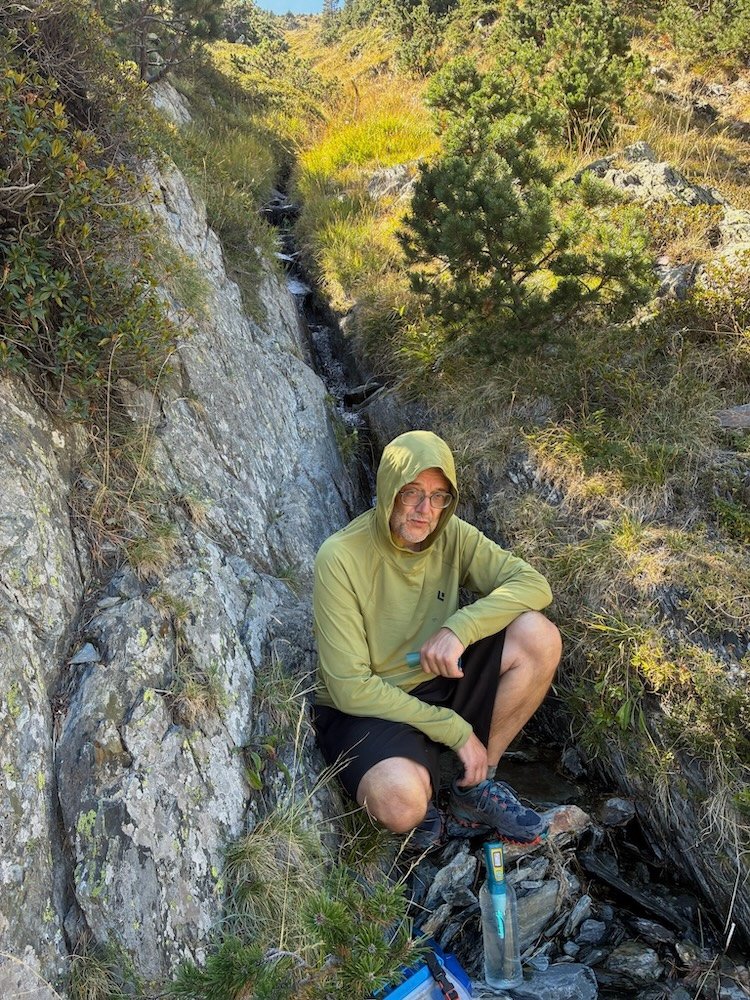
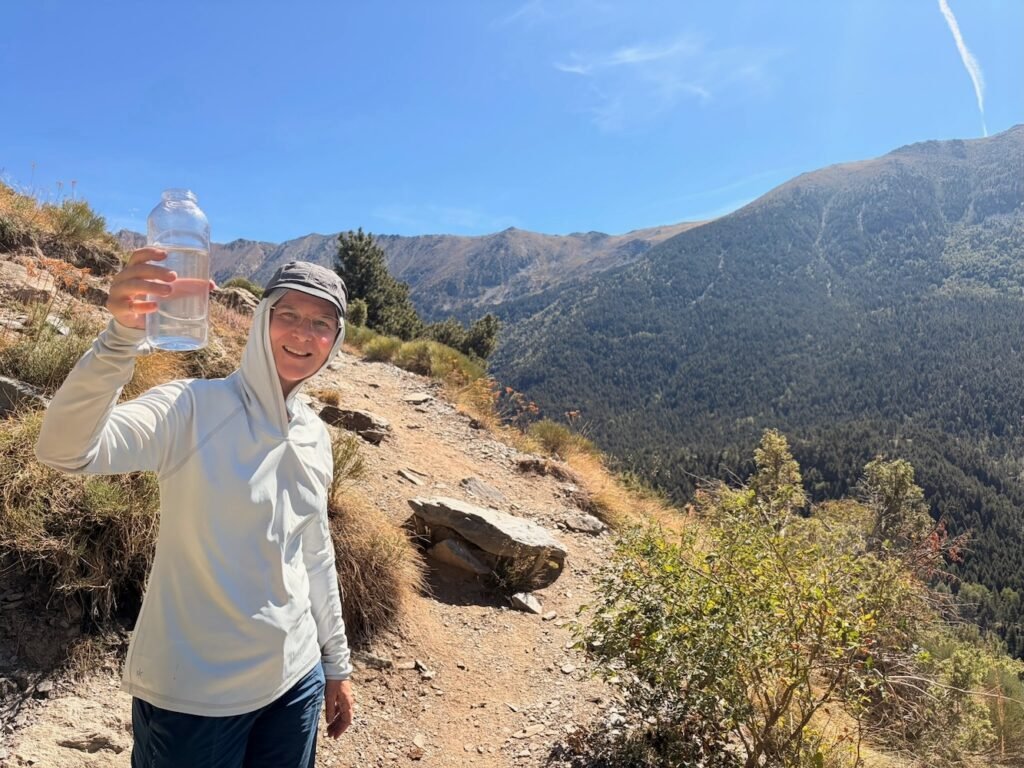
During a summer trek in the mountains, the temperature rose considerably. By the end of the day, the two of us had purified ten litres of water. Five litres each.
That might sound excessive to someone who has never spent a long, hot day hiking with a heavy rucksack. But when temperatures climb and the route involves hours of physical exertion, water becomes one of the most important considerations of the day.
It influences how much weight you carry, where you stop for a break and sometimes even which route you can take.
Fortunately, many mountain regions have streams, springs and other natural sources of water. A cold, crystal-clear stream flowing over rocks can look irresistible, particularly after a long climb.
But how safe is it?
Even the clearest mountain stream may contain harmful microorganisms. A water filter capable of removing almost every bacterium might still allow viruses to pass through. And water that is completely free from disease-causing organisms can still contain potentially harmful chemicals.
The opposite is equally important: not all untreated natural water is dangerous. The risks associated with a remote mountain spring are not necessarily the same as those of a stream flowing through a heavily grazed pasture.
Understanding these differences is the starting point for making informed decisions.
This dossier explores what can make natural water unsafe, how different treatment methods work and what their limitations mean in practice.
The European mountains provide the main setting, but the underlying principles apply equally to trekking in the Himalayas, travelling through Africa or exploring remote parts of South America.
The aim is not to identify one perfect water filter. It is to understand what makes water safe to drink — and how to achieve that reliably.
1. What can make natural water unsafe?
Water contamination falls into several broad categories. For hikers and travellers, the most relevant are bacteria, viruses, protozoan parasites, chemical contaminants and naturally occurring dissolved substances.
These categories matter because they require different treatment approaches.
A filter that removes bacteria may not remove viruses. A chemical disinfectant that kills viruses may leave heavy metals untouched. And water can be perfectly clear while containing either.
1.1 Bacteria: invisible passengers
Bacteria occur naturally throughout the environment. Most are harmless, and many play essential roles in ecological processes.
Some, however, can cause illness when ingested through contaminated water. Examples include Campylobacter, pathogenic strains of Escherichia coli (E. coli), Salmonella and Shigella.
Possible symptoms include diarrhoea, abdominal cramps, fever and vomiting.
In regions with inadequate sanitation, other bacterial diseases, including cholera, may also be relevant.
How do bacteria enter mountain streams?
One of the main sources is faecal contamination.
Cattle grazing on an alpine meadow, sheep crossing a stream, wild animals and people disposing of human waste too close to watercourses can all contribute. Rainfall can wash contaminated soil and animal droppings into nearby streams.
This means that water quality can change significantly over time.
A stream may contain relatively few microorganisms during a dry period, then experience a considerable increase following heavy rainfall.
An important consequence is that water quality cannot reliably be judged by appearance, smell or taste.
1.2 Viruses: much smaller than bacteria
Viruses are generally considerably smaller than bacteria.
Whereas bacteria are cells, viruses consist of genetic material enclosed within a protective protein structure. Some also possess an outer lipid envelope.
Viruses cannot reproduce independently. They must enter a suitable living host cell to multiply.
This sometimes creates confusion about their behaviour in drinking water.
Do viruses need bacteria to survive in water?
No.
Some viruses infect bacteria. These are known as bacteriophages. However, viruses responsible for human diseases, such as norovirus and hepatitis A, infect human cells.
When an infected person sheds virus particles, these may enter the environment through faecal contamination.
The virus particles can then remain in water without needing to be attached to bacteria. They cannot multiply there, but some can remain infectious.
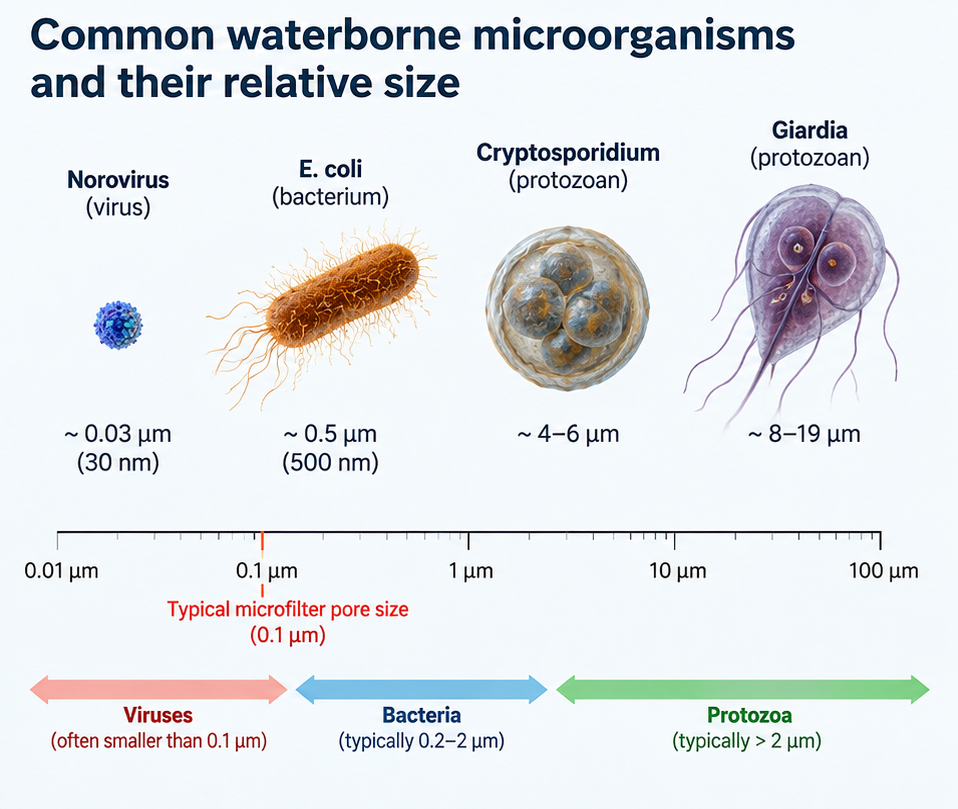
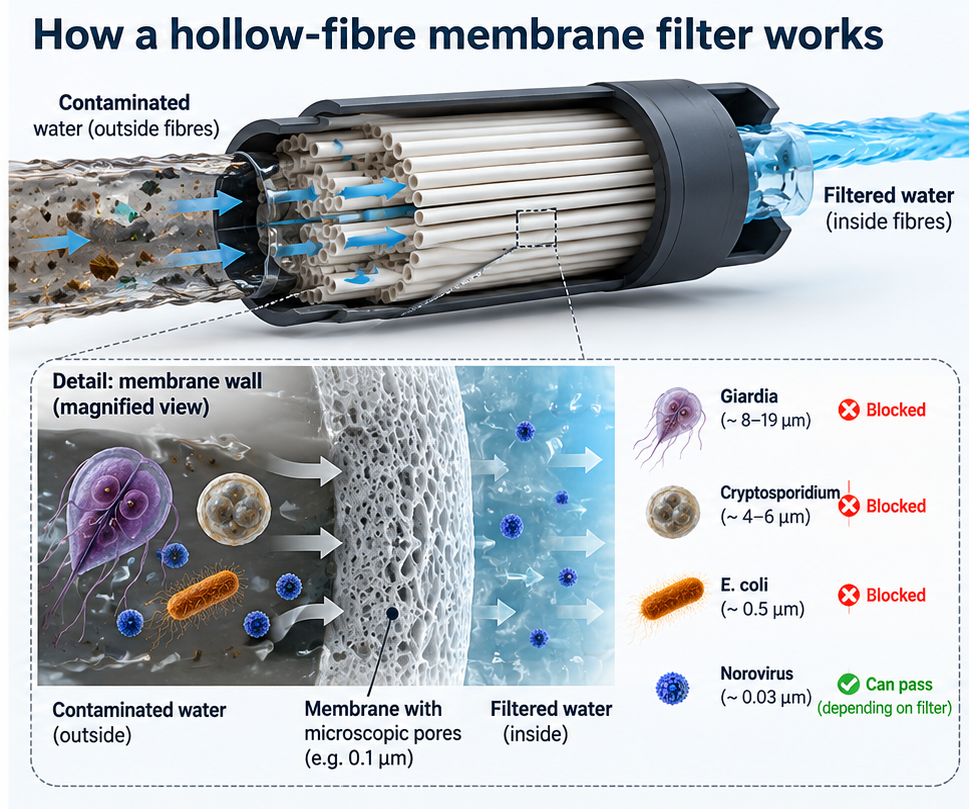
This distinction has important consequences for filtration. Many portable filters have pores measuring approximately 0.1–0.2 micrometres. A micrometre (µm) is one-thousandth of a millimetre.
Norovirus particles are approximately 0.03 µm in diameter — substantially smaller than the pores in many conventional hiking filters.
Consequently, a filter that reliably removes bacteria may still allow viruses to pass through. Some virus particles may be attached to larger suspended particles and get caught by a filter, but that cannot be relied upon.
Removing bacteria does not automatically mean removing viruses.
This is particularly relevant where water may have been contaminated by human sewage. The CDC identifies viruses as an important limitation of conventional portable microfilters.
Source: CDC — Water Disinfection for Travellers
1.3 Protozoan parasites: Giardia and Cryptosporidium
Two organisms deserve particular attention in the context of trekking: Giardia and Cryptosporidium.
Both can cause intestinal infections and can be transmitted through contaminated water.
They occur outside tropical regions, including in Europe.
Giardia
Giardia infects the small intestine.
Symptoms may include diarrhoea, abdominal discomfort, bloating, flatulence and fatigue.
The incubation period is often one to two weeks. Consequently, symptoms may only develop after a trek has ended.
The parasite is transmitted through resistant cysts that can survive in the environment.
These cysts are relatively large compared with bacteria and viruses, typically measuring several micrometres.
Appropriately designed microfilters can remove them effectively.
Cryptosporidium
Cryptosporidium can cause watery diarrhoea, sometimes lasting several weeks.
For people with weakened immune systems, an infection may be particularly serious.
This parasite is notable for its resistance to conventional chlorine disinfection.
Its environmentally resistant stage, known as an oocyst, can remain infectious under conditions where many bacteria would already have been inactivated.
This means that water treated with an ordinary chlorine tablet may still contain infectious Cryptosporidium.
A suitable physical filter, boiling or correctly applied chlorine dioxide treatment can provide protection.
How common are these parasites in European mountains?
Both occur in Europe, but there is no scientifically justified single estimate of the likelihood of infection from drinking a particular mountain stream.
Conditions vary considerably between locations.
The presence of grazing animals, human activity, rainfall patterns and the characteristics of the catchment all matter.
Importantly, identifying faecal indicator bacteria in water does not automatically prove that Giardia or Cryptosporidium is present.
Nevertheless, it indicates that contamination pathways exist.
1.4 Chemical contamination
Not every danger in drinking water is biological.
Water may also contain dissolved chemicals originating from agriculture, industry, mining activities, wastewater or natural geological processes.
Examples include pesticides, nitrates, certain heavy metals, fuels and industrial chemicals.
Many of these substances are invisible and may not noticeably affect the taste of water.
This creates a very different challenge from removing bacteria or parasites.
A conventional microfilter works primarily by trapping particles larger than its effective filtration threshold.
But dissolved chemicals may pass straight through.
Boiling is not a universal solution either. When water evaporates, the concentration of some non-volatile dissolved substances can actually increase.
Chlorine, chlorine dioxide and UV treatment are designed primarily for microbiological protection, not for comprehensive chemical removal.
Water that is microbiologically safe is not necessarily chemically safe.
This is why choosing an appropriate water source remains essential, even when carrying an excellent filtration system.
The CDC specifically advises against attempting to make water contaminated with toxic chemicals or fuel safe through ordinary boiling or disinfection.
Source: CDC — Household Water Treatment
1.5 Can natural water contain too many minerals?
Yes, although the presence of minerals is not inherently a problem.
As water travels through soil and rock, it dissolves small quantities of naturally occurring substances.
Calcium, magnesium, sodium and bicarbonate are common examples.
The geological environment strongly influences their concentrations.
Water flowing through limestone, for instance, may contain relatively high levels of calcium and magnesium.
This is known as hard water.
Hard water is generally not a health concern in itself.
However, some naturally occurring dissolved substances can become harmful at elevated concentrations.
Arsenic and fluoride are two examples. Both can occur naturally in groundwater, and prolonged exposure to excessive amounts can cause health problems.
Very high concentrations of dissolved salts can also make water unsuitable for drinking.
The important lesson is that dissolved substances cannot necessarily be removed by an ordinary trekking filter.
More specialised technologies, such as reverse osmosis, may be required.
For most hikers in remote European mountain environments, microbiological contamination is generally a more immediate concern, but local geology should not be ignored.
1.6 Cyanobacteria and algal toxins
Another possible danger comes from cyanobacteria, commonly called blue-green algae.
Cyanobacteria are bacteria, but they deserve separate attention because the main drinking-water concern is often the toxins they produce rather than an infection caused by the organisms themselves.
Certain species can produce toxins that affect humans and animals.
They are particularly associated with lakes, reservoirs and other bodies of water where conditions favour blooms.
Visible scum, unusual colouration or extensive algal growth are reasons to avoid a water source.
However, not every harmful bloom is obvious.
Ordinary boiling, chlorine treatment or a conventional trekking filter cannot be relied upon to remove all cyanobacterial toxins.
When such contamination is suspected, selecting another water source is generally safer than attempting to treat it using ordinary hiking equipment.
2. Where should you collect water in the mountains?
Good water treatment begins before water enters a filter.
Selecting a relatively uncontaminated source reduces the demands placed on the treatment system and the consequences of potential equipment failure.
No visual assessment can guarantee that natural water is safe. Nevertheless, understanding the surrounding environment can help reduce risk.
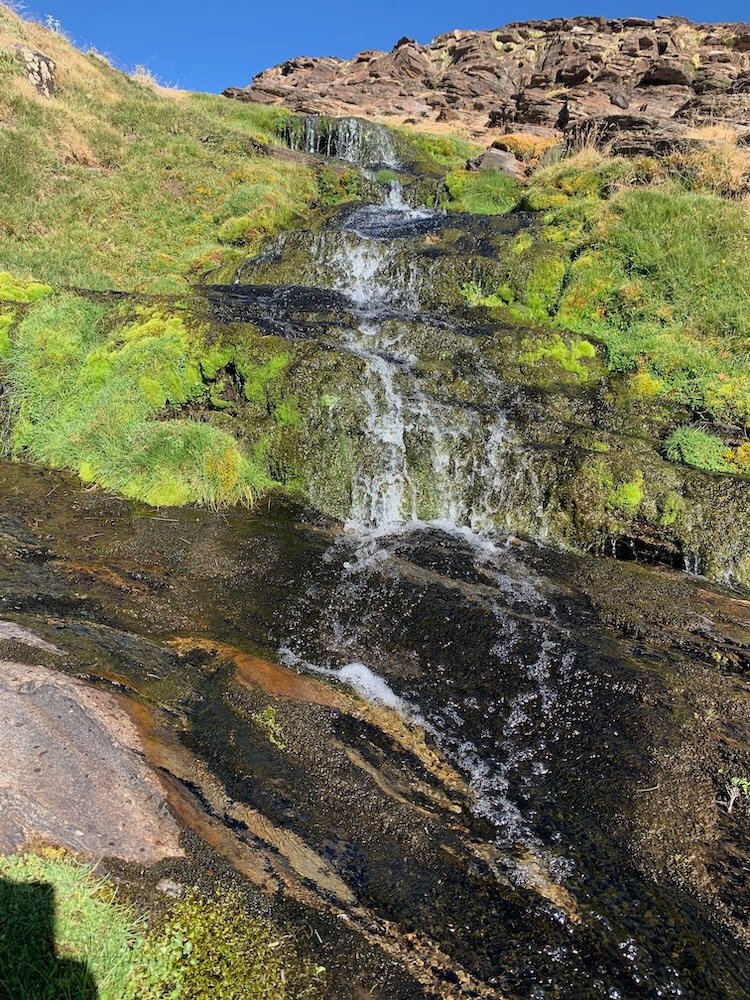
2.1 Are natural springs always safe?
A spring may appear to offer the purest possible water.
Water emerging directly from the ground often looks exceptionally clear, and underground movement through soil and rock can remove considerable amounts of suspended material and some microorganisms.
But groundwater quality depends on how the water reaches the spring.
A deep, protected aquifer may provide relatively effective natural filtration.
Other springs are much more vulnerable.
In limestone regions, water can sometimes travel rapidly through underground fractures and channels. Contaminants entering the ground at one location may reach a spring with relatively little natural filtration.
Consequently, a spring emerging directly from a rock face is not automatically safe to drink.
The same applies to water flowing from an old stone fountain or metal pipe.
Unless it forms part of a reliably monitored drinking-water supply, its microbiological quality may be unknown.
2.2 Is a fast-flowing mountain stream safer?
Fast-flowing water is often preferable to stagnant water when choosing between otherwise comparable sources.
But flowing water does not disinfect itself.
Nor does a waterfall make contaminated water safe.
A stream passing through remote terrain without obvious human activity or livestock may present fewer contamination opportunities than one flowing through pastures or settlements.
Nevertheless, wildlife can also introduce faecal microorganisms.
An Austrian study of alpine water resources investigated contamination associated with humans, livestock and wildlife, including chamois and deer. It demonstrated the relevance of these different sources when assessing mountain spring water.
Source: PubMed — Alpine Water Resources
The practical implication is that a stream’s entire upstream catchment matters, not just the few metres visible from where a bottle is filled.
2.3 Does rainfall affect water quality?
Potentially, and sometimes considerably.
Heavy rain can wash animal waste, human waste and contaminated soil into streams.
It may also increase turbidity — the amount of suspended material in the water.
This matters for two reasons.
First, the microbiological quality of the water may deteriorate.
Second, suspended particles can interfere with several treatment methods.
They may clog filters, consume chemical disinfectants or shield microorganisms from UV light.
A water source that was easy to treat during dry weather may therefore become much more difficult to manage after a storm.
2.4 What about snowmelt and glacier water?
Snow and ice are not guaranteed to be sterile.
Contamination may occur during snowfall, while snow lies on the ground or as meltwater travels over exposed surfaces.
Glacier-fed streams frequently contain fine mineral particles produced by abrasion of the underlying rock.
These particles create the characteristic milky appearance of some alpine rivers.
The particles themselves are not necessarily harmful, but they can cause rapid filter clogging.
Allowing particularly turbid water to settle before filtration can substantially reduce the amount of material reaching the filter.
Decanting the clearer water into a separate container can be a useful first step.
2.5 Can water at mountain huts be trusted?
Mountain huts do not always have access to public drinking-water networks.
Some rely on private springs, wells, snowmelt or collected rainwater.
The presence of a tap does not necessarily mean that the water has received the same treatment and monitoring as municipal drinking water.
A report from Austria’s Agency for Health and Food Safety (AGES) identified microbiological problems in a selection of establishments with private water supplies, including mountain huts and refuges.
Research in the Italian Dolomites has also examined differences between publicly supplied drinking water and alternative supplies at mountain huts.
Source: AGES — Drinking Water at Mountain Huts
These results should not be interpreted as evidence that mountain-hut water is generally unsafe.
They do demonstrate why a water supply should not be assumed to be safe simply because it is associated with a building.
Where drinking-water quality is uncertain, ask the hut operator whether the water is treated and suitable for drinking.
2.6 Digging a hole beside a stream: does natural filtration work?
Some survival manuals, including the SAS Survival Handbook, describe collecting water from a shallow hole dug beside a river or stream.
The idea is that water passing through the surrounding sand or gravel will be naturally filtered before collecting in the hole.
There is a genuine scientific principle behind this approach.
Large-scale drinking-water systems sometimes use riverbank filtration, in which river water passes through sediment before being collected by wells.
During this process, physical filtration, adsorption and biological activity can reduce the concentration of various contaminants.
A study of three full-scale riverbank filtration systems in the United States found substantial reductions in microorganisms compared with the original river water.
Source: PubMed — Riverbank Filtration
However, the comparison has an important limitation.
Professional riverbank filtration involves controlled or characterised conditions, including the distance travelled through sediment, groundwater residence time and the properties of the filtration medium.
A shallow hole dug beside a stream provides none of these guarantees.
The collected water may appear much clearer while remaining microbiologically unsafe.
Digging a hole beside a stream may improve water clarity, but it is not a reliable standalone drinking-water treatment method.
It should be considered a possible pre-treatment technique rather than an alternative to proven filtration or disinfection.
Any such intervention should also take account of environmental damage to riverbanks and surrounding vegetation.
3. Water treatment: removing contaminants or making them harmless?
Water treatment methods can be divided into three broad categories.
Physical filtration removes particles and microorganisms by preventing them from passing through a filter medium.
Disinfection kills or inactivates microorganisms, preventing them from causing infection.
Specialised separation and adsorption technologies can remove certain dissolved chemicals or ions.
Some treatment systems combine several of these principles.
Understanding the difference is essential because water that looks clean is not necessarily safe, and water that has been disinfected may still contain suspended particles or dissolved chemicals.
3.1 Boiling water
Boiling remains one of the most reliable ways of dealing with microbiologically contaminated water.
The CDC recommends bringing clear water to a rolling boil for one minute.
At elevations above approximately 2,000 metres, it recommends three minutes.
These recommendations include a practical safety margin.
Common waterborne pathogens are inactivated by heat, often before the water reaches boiling point. Boiling provides an easily recognisable endpoint without requiring specialist equipment or a thermometer.
Source: CDC — Water Disinfection
What are the advantages?
Boiling is effective against bacteria, viruses and protozoan parasites, including Giardia and Cryptosporidium.
It does not depend on the integrity of a membrane or the effectiveness of a chemical product.
What are the disadvantages?
For trekking, the practical limitations can be considerable.
Heating several litres of water requires fuel.
The process takes time, particularly at low ambient temperatures or when using a small camping stove.
And there is another inconvenience that is often overlooked.
After boiling, the water must cool before it can be comfortably drunk.
Imagine arriving at a mountain stream after several hours of walking in hot weather. You are thirsty and would particularly appreciate cold water.
Boiling provides microbiological protection, but it does not provide an immediate refreshing drink.
Depending on the volume and environmental conditions, cooling may take a substantial amount of time.
Kettles, cooking pots and clean containers can help, but the delay remains.
Finally, boiling does not reliably remove chemical contaminants.
Can some organisms survive boiling?
Yes. Certain organisms or biological structures have remarkable heat resistance.
Tardigrades, also known as water bears, are a fascinating example.
Some species can enter a dormant state after losing almost all their body water. In this desiccated state, they can survive environmental conditions that would normally be fatal.
A 2009 study found that more than 90% of desiccated Milnesium tardigradum specimens survived exposure to 100 °C for an hour.
But this does not mean that active tardigrades can swim around unharmed in boiling water.
Their exceptional heat resistance is associated with the dehydrated dormant state. Research published in 2020 demonstrated that active, hydrated tardigrades can be surprisingly sensitive to elevated temperatures.
Source: PubMed — Tardigrade Heat Resistance
Certain bacterial spores can also survive ordinary boiling.
Does that mean boiling is unreliable?
Not for its intended purpose.
The aim of drinking-water treatment is not to destroy every biological structure that could theoretically survive heat.
It is to reduce the organisms capable of causing illness through drinking water to sufficiently safe levels.
Standard boiling recommendations remain highly effective against recognised waterborne pathogens.
There is therefore no reason for trekkers to abandon boiling because some unusual organisms or bacterial spores possess exceptional heat resistance.
3.2 Mechanical water filters
Mechanical water filtration is one of the most widely used methods of treating water during trekking.
The principle is straightforward: water passes through a material containing openings small enough to retain certain contaminants.
The difficulty lies in understanding which contaminants are actually removed.
Portable filters use several types of filtration media, including ceramic elements, glass-fibre materials and hollow-fibre membranes.
Their effectiveness depends on the filtration material, its pore structure, the integrity of the filter and the conditions under which it operates.
Understanding pore size
Pore size is generally expressed in micrometres (µm).
One micrometre equals 0.001 millimetres.
Many common trekking filters have a stated pore size of approximately 0.1–0.2 µm.
To understand what this means, it helps to compare the approximate dimensions of different microorganisms.
| Organism | Approximate size | Implications for filtration |
| Giardia cysts | 8–19 µm | Readily retained by suitable microfilters |
| Cryptosporidium oocysts | 4–6 µm | Readily retained by suitable microfilters |
| E. coli bacteria | Approximately 0.5 µm wide | Retained by appropriately rated microfilters |
| Norovirus | Approximately 0.03 µm | Can pass through conventional microfilters |
These dimensions illustrate why conventional microfiltration can provide excellent protection against bacteria and protozoa without reliably removing viruses.
However, dimensions alone do not establish the performance of a commercial filter.
The actual removal efficiency must be demonstrated through appropriate testing.
3.3 Nominal versus absolute pore size
Two filters may both advertise a pore size of 0.2 µm while providing different levels of particle removal.
One reason is the distinction between nominal and absolute filtration ratings.
Nominal pore size
A nominal rating indicates that a filter removes a specified proportion of particles at or above a particular size.
However, there is no universally accepted efficiency threshold defining every nominal rating.
One manufacturer’s nominal filter may remove 90% of particles of a stated size, while another may achieve a higher percentage.
The precise definition depends on the testing method and the manufacturer’s specifications.
A nominal rating therefore does not guarantee that every particle larger than the stated size will be removed.
Absolute pore size
An absolute rating generally indicates a much higher and more clearly defined particle-removal performance.
It is sometimes explained as the maximum pore size present in a filter medium.
In practice, however, absolute ratings are also commonly associated with a specified removal efficiency under defined test conditions.
The terminology is not completely standardised across the filtration industry.
Consequently, even an absolute rating should not be interpreted as an unconditional guarantee of complete microbial removal.
Filtration specialists emphasise the importance of examining actual retention efficiency and test conditions rather than relying solely on nominal or absolute ratings.
Which is better?
For critical drinking-water applications, an independently demonstrated microbiological removal performance is generally more informative than a nominal pore-size rating.
A filter claiming an absolute pore size of 0.2 µm should still be assessed according to the organisms it has actually been tested against.
Pore size helps explain how a filter works. Microbiological testing tells us more about how well it protects the user.
3.4 What does 99.9999% removal really mean?
Manufacturers often describe filtration performance using percentages.
A filter might claim to remove 99.9999% of bacteria.
This sounds impressive, but it is important to understand what the number represents.
Microbiological removal efficiency is often expressed using logarithmic reduction values, usually abbreviated to log reduction.
| Log reduction | Percentage reduction | Organisms remaining from an initial million |
| 1-log | 90% | 100,000 |
| 2-log | 99% | 10,000 |
| 3-log | 99.9% | 1,000 |
| 4-log | 99.99% | 100 |
| 5-log | 99.999% | 10 |
| 6-log | 99.9999% | 1 |
A 6-log reduction corresponds to a millionfold reduction in the concentration of the organism tested.
It does not mean that the filter can never allow a microorganism to pass through.
Nor does it tell us anything about organisms that were not included in the test.
A 6-log reduction for bacteria does not automatically imply equivalent protection against viruses.
Are there independent testing standards?
Yes.
One relevant protocol is NSF P231, which addresses microbiological water purifiers.
The performance targets associated with the US Environmental Protection Agency’s microbiological purifier guidance include:
- At least 6-log reduction of bacteria.
- At least 4-log reduction of viruses.
- At least 3-log reduction of protozoan cysts.
The World Health Organization also operates an international evaluation scheme for household water-treatment technologies.
Its assessments distinguish between protection against bacteria, viruses and protozoa.
Importantly, a manufacturer’s claim that a product has been tested according to a particular protocol is not necessarily equivalent to independent product certification.
The CDC notes that the US EPA does not independently test manufacturers’ claims under its purifier guidance.
Source: CDC Yellow Book
Why is the required reduction lower for protozoa than for bacteria?
These figures are minimum performance requirements, not an indication of how difficult each organism is to remove by filtration. The original EPA criteria were based partly on expected contamination levels and the degree of treatment considered necessary to protect drinking water. Because Giardia and Cryptosporidium are considerably larger than bacteria, a properly designed microfilter will generally retain them at least as effectively. However, the actual removal performance must still be demonstrated through appropriate testing.
3.5 Can filters remove molecules?
Yes. But this requires considerably finer filtration technologies.
Conventional microfiltration primarily removes suspended particles and microorganisms.
Other membrane technologies can retain much smaller contaminants.
Ultrafiltration
Ultrafiltration uses finer membranes than conventional microfiltration.
Appropriately designed ultrafilters can remove bacteria, protozoa and viruses.
Some portable systems use hollow-fibre ultrafiltration membranes and can operate through manual pressure or gravity.
Because the membranes are very fine, water generally passes through them less easily than through coarser filters.
Nanofiltration
Nanofiltration operates at an even finer level.
It can remove certain dissolved organic molecules and ions.
Performance depends on membrane characteristics, molecular size, electrical charge and the composition of the water.
Nanofiltration generally requires higher pressure than microfiltration.
Reverse osmosis
Reverse osmosis uses a highly selective membrane and applied pressure to separate water from many dissolved substances.
It can remove substantial quantities of dissolved salts, making it suitable for applications such as seawater desalination.
However, reverse osmosis systems require more complex equipment, considerable pressure and a way to dispose of the concentrated reject water.
These characteristics make them generally unsuitable for lightweight trekking.
Is molecular filtration the ultimate solution?
Not necessarily.
Removing progressively smaller contaminants usually requires more complex treatment, more pressure or more energy.
And no filter should be assumed to remove every chemical simply because it operates at a molecular scale.
The relevant question is which specific substances a technology has been demonstrated to remove.
3.6 Activated carbon
Some portable filters incorporate activated carbon.
Activated carbon works mainly through adsorption: certain substances become attached to its extensive internal surface.
This can improve taste and odour and remove some dissolved organic contaminants.
However, activated carbon is selective.
Its performance depends on the substances present, the type of carbon, contact time and the amount of water already treated.
Once the available adsorption sites become occupied, the carbon’s effectiveness decreases.
Activated carbon cannot therefore be treated as a universal solution for chemical contamination.
Nor should an activated-carbon cartridge be considered a reliable standalone method for removing infectious microorganisms.
4. The different types of portable water filters
The filtration medium is only part of a water filter’s design.
Equally important is how water passes through it.
This affects the amount of physical effort required, the treatment rate and the practicality of the system during a trek.
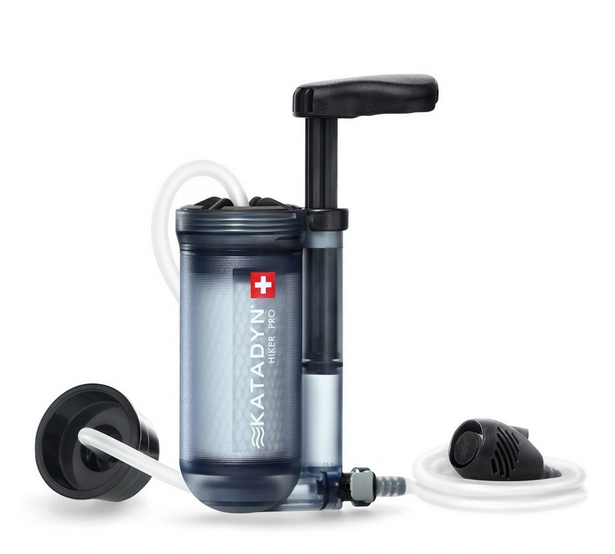
(example: Katadyn Hiker Pro)
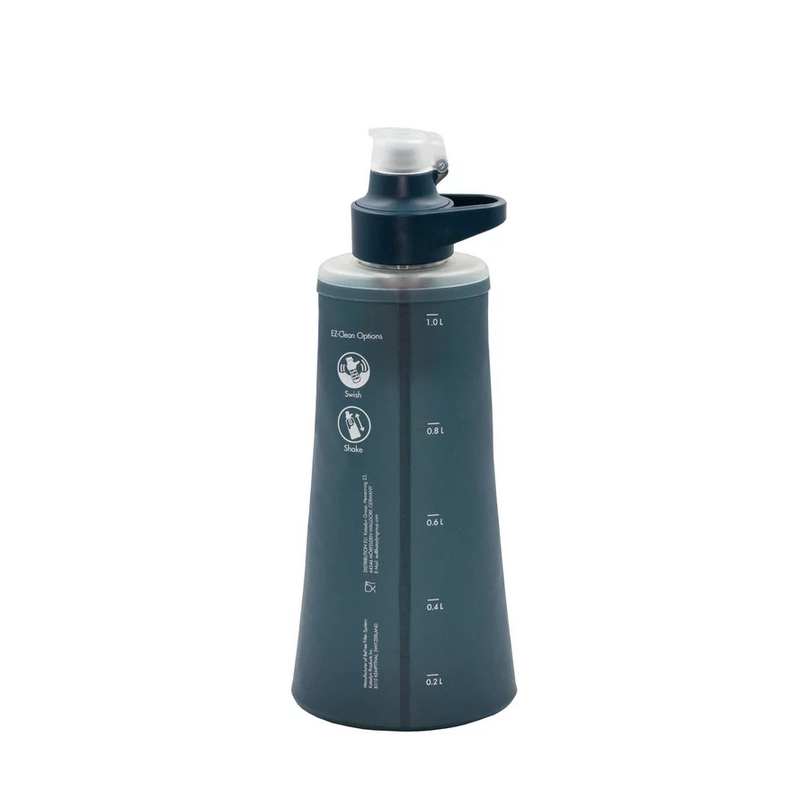
(example: Katadyn BeFree)
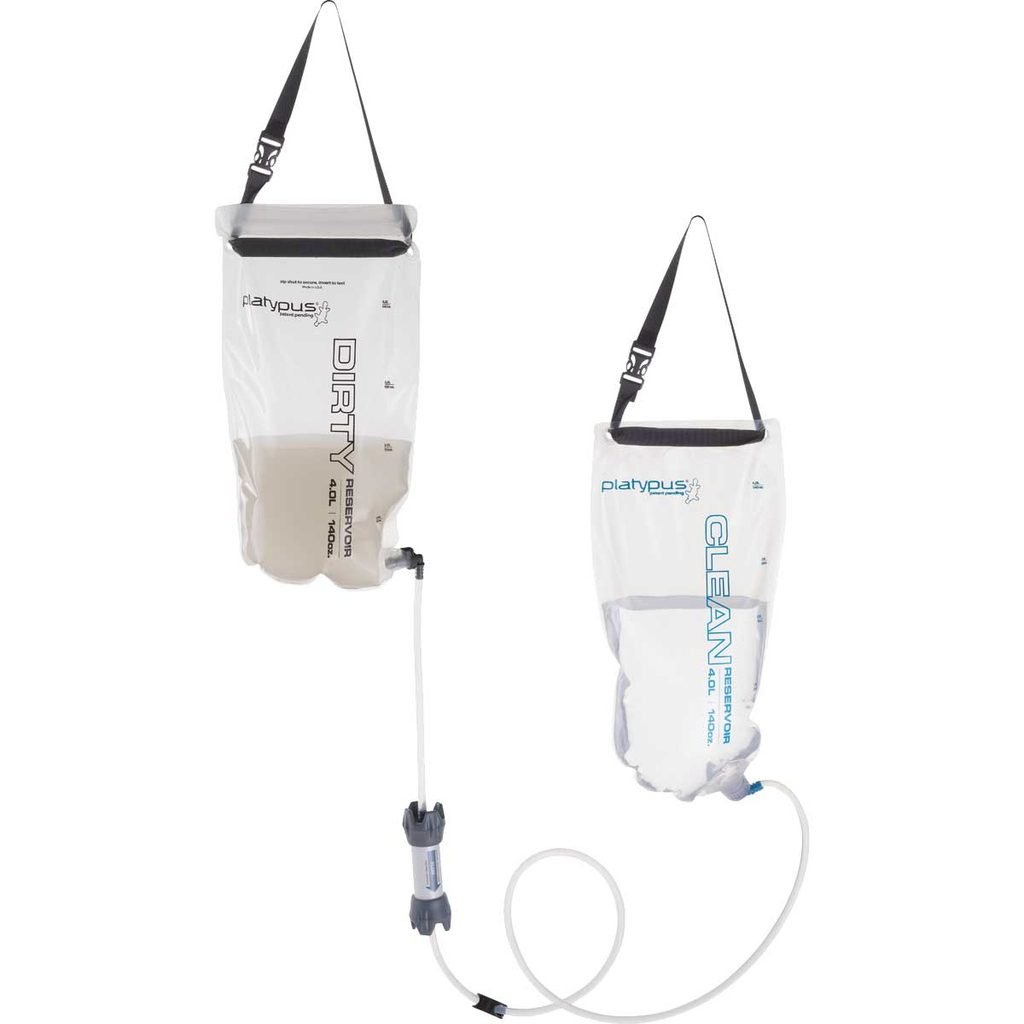
(example: Platypus Gravityworks)
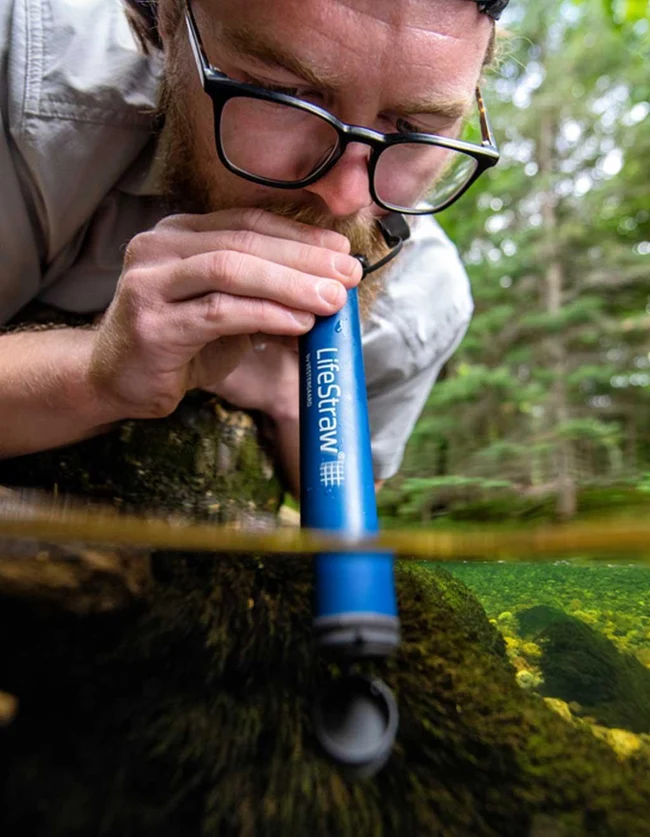
(example: Lifestraw)
4.1 Hand-pump filters
Hand-pump filters use a manually operated mechanism to force water through a filter element.
They typically include an intake hose, a pump and a replaceable or cleanable filtration cartridge.
The user controls the flow by operating the pump.
Some designs are particularly robust and can cope with relatively challenging water sources.
However, pumping requires physical effort.
When the filter is new and clean, the process may be relatively easy. As particles accumulate, resistance can increase.
Filtering several litres may then become tiring.
For someone treating ten litres of water every day, this is not a minor consideration.
Examples include the Katadyn Pocket and Hiker Pro.
4.2 Squeeze filters
Squeeze filters use a flexible reservoir filled with untreated water.
The user squeezes the reservoir, forcing water through the filter.
These systems can be remarkably lightweight and compact.
Examples include the Sawyer Squeeze and Katadyn BeFree.
Their main advantage is the simplicity of the design.
However, squeezing becomes more demanding as the filter clogs.
The durability of the soft reservoir is another consideration, particularly during extended journeys.
4.3 Gravity filters
Gravity filters use the weight of water to create the pressure needed for filtration.
An untreated-water reservoir is suspended above a clean-water container, allowing water to flow through the filter without manual pumping.
This can be particularly convenient when treating several litres at once.
While the filter operates, a trekker can prepare food, organise equipment or rest.
However, gravity filters require a suitable arrangement for suspending the reservoir.
The flow rate also decreases as the filter becomes clogged.
Examples include Platypus GravityWorks and gravity-fed versions of the Katadyn BeFree system.
4.4 Straw filters
A straw filter allows water to be drawn directly through a filtration element by suction.
The user can drink from a container or, where practical, directly from a water source.
LifeStraw is a well-known example.
Such filters are simple and compact, but they are not necessarily the most convenient solution for extended trekking.
They generally do not provide an easy way of producing several litres of treated water for cooking or storage.
One particularly useful application may be ordinary travel.
For example, a traveller staying in a guesthouse where tap-water quality is uncertain may appreciate a compact drinking filter.
However, this is only a suitable solution if the filter provides protection against the relevant contaminants.
A straw filter that removes bacteria but not viruses may be inadequate where drinking-water supplies are vulnerable to sewage contamination.
This illustrates why the type of journey matters as much as the design.
4.5 Bottle and press filters
Some products integrate the filtration system into a drinking bottle.
Certain designs allow the user to drink through the filter.
Others use a press mechanism to force water through a cartridge into a clean reservoir.
These systems combine storage and treatment in one unit.
Some specialised models can remove viruses as well as bacteria and protozoa.
However, the quantity of water treated per cycle may be limited by the size of the bottle.
For large daily volumes, repeated pressing or refilling can become inconvenient.
4.6 Comparing the main designs
| Filter design | Main advantage | Main limitation | Particularly relevant for |
| Hand pump | Controlled filtration | Physical effort and maintenance | Remote trekking and demanding conditions |
| Squeeze filter | Low weight and simple construction | Squeezing effort and reservoir durability | Lightweight backpacking |
| Gravity filter | Treats larger volumes with little effort | Requires time and a suitable set-up | Couples, groups and camping |
| Straw filter | Very compact; immediate drinking | Limited water collection and no storage | Travel and occasional use |
| Bottle filter | Convenient integrated system | Limited capacity per cycle | Travel and day hiking |
| Press filter | Relatively quick batch treatment | Repeated physical effort | Travel and smaller water volumes |
These are differences in operation, not guarantees of microbiological performance.
A gravity filter and a squeeze filter may use exactly the same type of membrane.
Conversely, two similar-looking bottle filters may provide very different levels of protection.
4.7 Clogging and maintenance
A common weakness of mechanical filters is clogging.
Suspended particles accumulate on or within the filtration medium, reducing water flow.
The effects can range from a minor inconvenience to a serious problem.
A hand pump may become increasingly difficult to operate.
A squeeze filter may require substantially more pressure.
A gravity filter may slow to a trickle.
Different technologies require different maintenance methods.
Some hollow-fibre filters can be cleaned by forcing treated water backwards through the membrane, a process known as backflushing.
Certain ceramic elements can be cleaned by carefully removing a thin layer of material from the surface.
Other cartridges must be replaced.
Maintenance instructions are product-specific and should never be improvised.
What about freezing?
Freezing presents a particular risk for some hollow-fibre membranes.
After a filter has been used, residual water may remain inside the fibres.
If that water freezes, expanding ice can damage the membrane.
The damage may be invisible, even though the filter can no longer provide its intended protection.
For this reason, certain manufacturers recommend replacing a used filter if it may have frozen.
During winter trekking, the filter may need to be kept inside clothing or protected within a sleeping bag overnight.
A lightweight filter that works perfectly in summer may therefore require additional precautions in winter.
4.8 The human factor
An often overlooked source of contamination is the person operating the filter.
A filtration system can perform extremely well in laboratory testing and still fail to protect the user during an ordinary trek.
Imagine placing the clean outlet of a filter on the ground, dropping it into untreated water or handling it with contaminated fingers.
The filter itself may continue working perfectly.
But microorganisms can bypass the filtration process through contaminated surfaces.
The same applies to water bottles.
A bottle filled with treated water can be contaminated by its cap, neck or threads.
Dirty hands, incorrectly connected hoses and accidentally mixing untreated and treated water present similar risks.
A good system therefore needs more than an effective filtration membrane.
It needs a design and routine that reduce opportunities for mistakes.
Keeping separate untreated- and treated-water containers, maintaining clean outlet connections and handling equipment carefully can make a significant difference.
The safest filter is not necessarily the one with the most impressive laboratory specification. It is the one that provides appropriate protection and can be used reliably in real conditions.
5. Chemical water treatment
Chemical disinfectants provide an alternative to mechanical filtration.
Their main advantages are compactness, low weight and the ability to treat different volumes of water without pumping.
However, chemical treatments do not all work against the same organisms.
The most relevant substances for travellers include chlorine, chlorine dioxide, iodine and silver compounds.
Both chlorine and chlorine dioxide can affect the taste and smell of treated water. Chlorine often leaves a noticeable swimming-pool-like taste, while chlorine dioxide generally has a milder taste and may leave little noticeable aftertaste. The result depends on the product, dosage and water quality.
5.1 Chlorine
Chlorine has been used for drinking-water disinfection for more than a century.
Commercial products may contain compounds such as sodium hypochlorite or sodium dichloroisocyanurate.
These release active chlorine species into water.
One important disinfecting compound is hypochlorous acid, HOCl.
It reacts with essential components of microorganisms, damaging their ability to survive or reproduce.
Chlorine is effective against many bacteria and viruses when the correct concentration and contact time are used.
However, some protozoan parasites are more resistant.
Giardia generally requires more demanding treatment conditions than many bacteria.
Cryptosporidium is particularly resistant to ordinary chlorine concentrations.
Consequently, conventional chlorination should not be considered a reliable standalone method for protecting against Cryptosporidium under typical trekking conditions.
The effectiveness of treatment also depends on water temperature, pH, organic matter and contact time.
Cold, turbid mountain water can therefore be more difficult to disinfect than clear water at room temperature.
5.2 Chlorine dioxide: a different chemical
Chlorine and chlorine dioxide are often confused.
Both are used for drinking-water disinfection, but they are chemically distinct.
Conventional chlorination typically relies on hypochlorous acid and hypochlorite.
Chlorine dioxide has the chemical formula ClO₂.
It is a separate oxidising compound with different disinfection characteristics.
This distinction matters particularly when treating water that may contain protozoan parasites.
Why use chlorine dioxide?
Chlorine dioxide can inactivate Cryptosporidium under appropriate conditions.
This gives it an important advantage over ordinary chlorination.
It is also effective against many bacteria and viruses.
However, chlorine dioxide is not instantaneous.
The contact time needed to inactivate resistant organisms may extend to several hours.
Water temperature, clarity and the concentration of the disinfectant all influence treatment performance.
A product may therefore require different contact times for bacteria, viruses and Cryptosporidium.
A tablet that disinfects against bacteria in 30 minutes should not automatically be considered effective against every parasite after the same period.
The CDC recognises chlorine dioxide as an effective field treatment but emphasises the importance of sufficient contact time.
Source: CDC — Water Disinfection
Are commercial chlorine dioxide products available?
Yes.
One example is Lifesystems Chlorine Dioxide Water Purification Tablets.
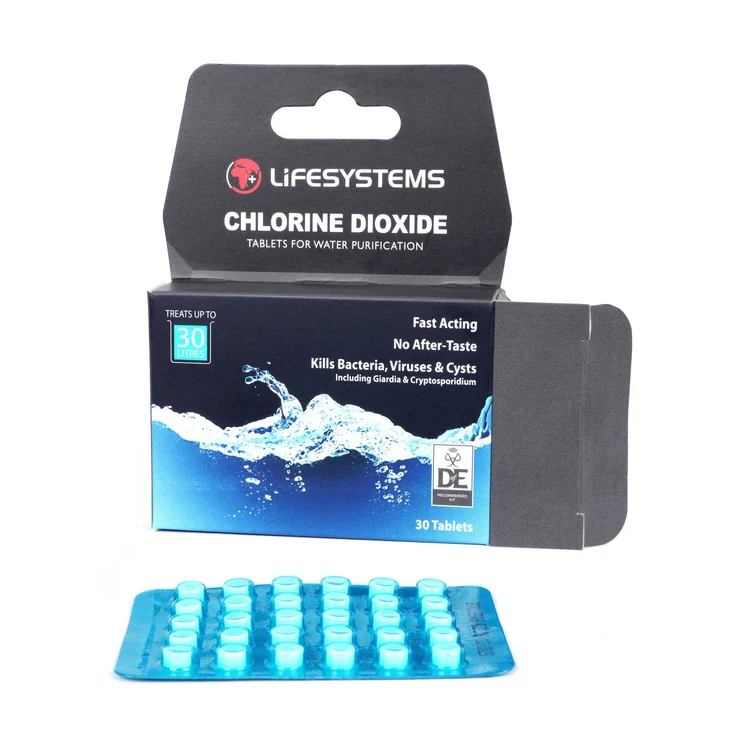
These are sold in packs designed to treat 30 litres of water.
The manufacturer describes them as suitable for treating water against bacteria, viruses and cysts, including Giardia and Cryptosporidium.
They are sold through outdoor retailers in several European countries.
Another example is the company’s two-part chlorine dioxide liquid treatment.
These are illustrations of the technology, not independent endorsements of specific product claims.
The legally authorised uses and current availability should be checked in the country of purchase.
Disadvantages of chlorine dioxide
Chlorine dioxide is more demanding to use correctly than its small tablets might suggest.
The appropriate contact time must be respected.
Some treatments require several hours before the water can be consumed with the intended level of protection.
There may also be an unpleasant taste, although this varies between products and users.
Chlorine dioxide can produce chemical by-products, including chlorite and chlorate.
These are regulated because exposure to excessive concentrations can present health concerns.
Using more disinfectant than recommended is therefore not a sensible way to achieve additional protection.
Only products specifically intended and authorised for drinking-water treatment should be used, and their instructions must be followed carefully.
Why choose chlorine instead of chlorine dioxide?
Chlorine dioxide offers broader protection against waterborne pathogens, particularly Cryptosporidium. However, conventional chlorine remains a useful choice because it is generally inexpensive, widely available and effective against many bacteria and viruses.
When combined with a suitable microfilter that removes protozoan parasites, chlorine can provide an effective additional barrier against viruses. Chlorine dioxide may be preferable when a single chemical treatment must also address Cryptosporidium, provided the necessary contact time is respected.
5.3 Silver: preserving water and protecting filter materials
Silver has antimicrobial properties.
Silver ions can interfere with microorganisms and inhibit the growth of certain bacteria.
In water treatment, however, silver is used in several different ways.
Understanding these applications prevents confusion.
Silver for water preservation
Silver compounds are sometimes used to help maintain the microbiological quality of water during storage.
Examples include water stored in tanks on boats, motorhomes or caravans.
The purpose is primarily to inhibit microbial growth and reduce the risk of deterioration over time.
This is not equivalent to rapidly disinfecting an unknown mountain stream.
Silver treatment alone should not be relied upon as a comprehensive method for removing all relevant waterborne pathogens.
Silver combined with chlorine
Some products combine silver compounds with a chlorine-releasing disinfectant.
The chlorine provides the principal initial disinfection.
Silver contributes to limiting microbial growth during storage.
The precise effects and permitted claims depend on the individual formulation.
Silver within ceramic filters
Silver can also be incorporated into filter materials.
Certain ceramic filter elements are impregnated with silver to reduce microbial growth within the filtration medium.
Katadyn uses silver-impregnated ceramic in products such as the Pocket filter.
Source: Katadyn
This is a different function from the physical removal of bacteria by the ceramic pores.
It is also important to distinguish between metallic silver, silver ions and silver salts such as silver nitrate.
These are chemically different forms of silver.
The general statement that a filter contains silver does not establish which compound was used in its manufacture.
Nor does it establish that the water leaving the filter has been independently disinfected by silver.
5.4 Iodine
Iodine has historically been used for emergency drinking-water disinfection.
It can be effective against many bacteria and viruses.
However, it has limitations, particularly against resistant protozoan parasites.
Prolonged use can also affect thyroid function.
For these reasons, iodine is generally less attractive as a regular treatment method during extended travel.
People with thyroid disorders and pregnant travellers require particular caution.
The CDC recommends limiting the duration of iodine-treated water consumption and using alternatives where appropriate.
Source: CDC Yellow Book
6. Ultraviolet light
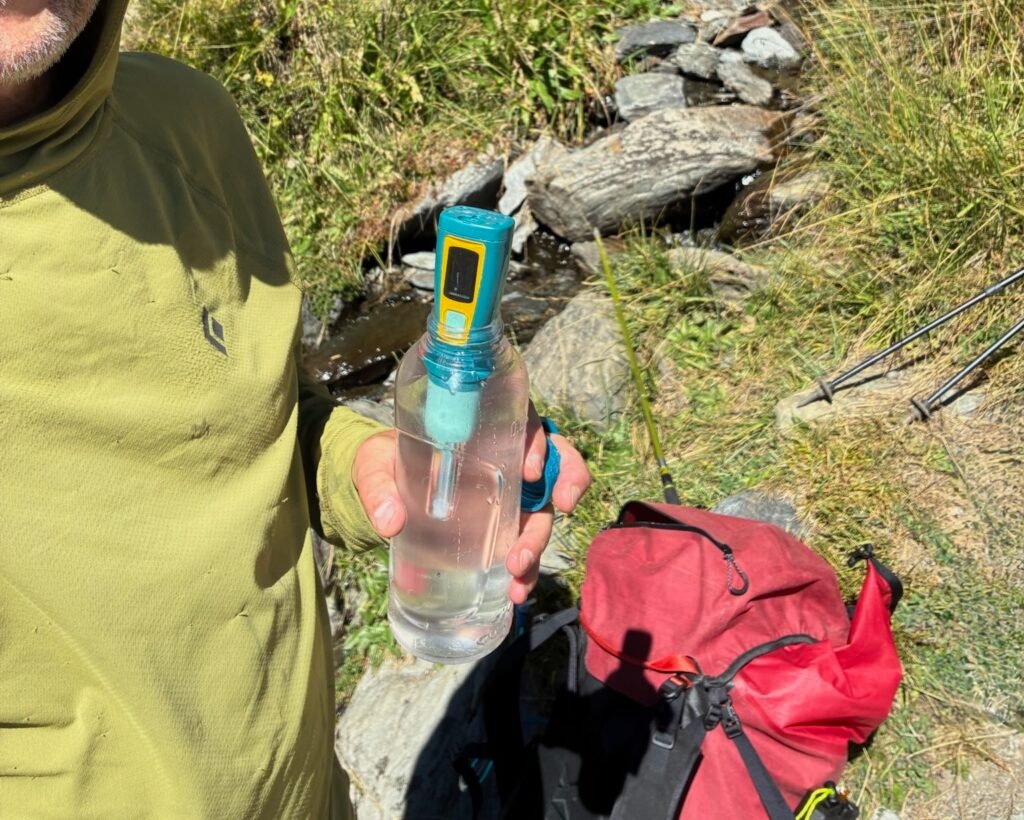
Ultraviolet light offers another approach to water disinfection.
UV treatment works by damaging the genetic material of microorganisms, preventing them from reproducing or causing infection.
Correctly applied UV treatment can be effective against bacteria, viruses and protozoa.
Unlike conventional filtration, it does not physically remove the organisms.
Instead, it inactivates them.
The advantages
UV treatment does not require chemical disinfectants.
It does not normally alter the taste of water.
Portable devices can treat relatively small quantities of clear water quickly.
This makes them attractive for travelling, especially when access to electricity or rechargeable batteries is reliable.
The limitations
UV light must reach the microorganisms to be effective.
Suspended particles can shield pathogens from exposure.
Consequently, turbid water may need to be clarified or filtered before UV treatment.
Portable systems also depend on a functioning UV source and sufficient electrical power.
Correct exposure time and treatment volume are essential.
Unlike physical filtration, UV treatment does not remove particles or dissolved chemical contaminants.
It also provides no continuing protection against contamination after treatment.
Is a UV purifier a water filter?
Strictly speaking, not necessarily.
A UV-only device is a disinfecting system rather than a mechanical filter.
This distinction matters when comparing technologies.
A UV purifier can inactivate microorganisms without removing them or improving the physical clarity of the water.
For example, SteriPEN devices use UV light as their principal treatment method.
They should not be confused with membrane filters merely because both are marketed for water purification.
7. Which treatment methods protect against which contaminants?
The following table summarises the general capabilities of the principal technologies.
It describes technologies rather than guaranteeing the performance of individual products.
| Treatment method | Bacteria | Viruses | Giardia | Cryptosporidium | Dissolved chemicals |
| Boiling | Effective | Effective | Effective | Effective | Not reliably removed |
| Suitable microfilter | Effective | Generally insufficient | Effective | Effective | Generally insufficient |
| Suitable ultrafilter | Effective | Can be effective | Effective | Effective | Generally insufficient |
| Conventional chlorine | Effective | Effective | Conditional | Generally insufficient | Not reliably removed |
| Chlorine dioxide | Effective | Effective | Effective with correct treatment | Effective with sufficient contact time | Not reliably removed |
| Silver ions alone | Limited and application-dependent | Not reliably established | Not reliable | Not reliable | Not removed |
| UV treatment | Effective | Effective | Effective | Effective | Not reliably removed |
| Activated carbon | Not a reliable standalone microbial treatment | Not reliable | Not reliable | Not reliable | Removes selected substances |
| Reverse osmosis | Effective with a suitable system | Effective with a suitable system | Effective | Effective | Removes many dissolved substances |
The word effective assumes that the treatment is properly designed, validated and used according to its instructions.
For portable equipment, this is a critical qualification.
A poorly maintained filter or an incorrectly used UV device cannot be assumed to provide the same protection as a properly tested and functioning system.
Combining methods
Some travellers combine physical filtration with chemical disinfection.
A conventional microfilter can remove bacteria and protozoa.
A subsequent disinfectant can address viruses that the filter may not reliably remove.
This provides a broader approach to microbiological water safety.
The CDC recommends boiling as the most reliable straightforward treatment and identifies filtration followed by disinfection as a strong alternative when boiling is impractical.
Source: CDC — Water Treatment
However, combining methods does not eliminate the need to choose appropriate water sources.
Neither filtration nor ordinary disinfection can be assumed to make heavily chemically contaminated water safe.
8. Is water treatment different outside Europe?
The basic science remains the same throughout the world.
A virus does not become larger simply because it is present in Switzerland rather than Nepal.
A membrane that cannot reliably remove a particular microorganism in Europe will have the same limitation elsewhere.
What changes is the likelihood of encountering different forms of contamination.
European mountain regions
In remote European mountain environments, bacteria and protozoa associated with wildlife, livestock and human activity are important considerations.
Waterborne viruses remain possible, particularly where human sewage may reach watercourses.
The risks vary considerably between different mountain regions and individual sources.
Asia
Some areas have highly developed drinking-water infrastructure, while others face significant challenges involving untreated wastewater and sanitation.
In regions where human faecal contamination is more likely, protection against waterborne viruses becomes particularly important.
Naturally occurring chemical contamination, including arsenic in groundwater, is also a serious problem in certain regions.
A microbiological water filter is not a solution to arsenic contamination.
Africa
Conditions vary greatly across the continent.
In areas with inadequate sanitation, drinking-water treatment may need to address substantial bacterial, viral and protozoan contamination.
Other environmental health risks may also be present.
Schistosomiasis, for example, can be acquired through skin contact with contaminated freshwater.
A drinking-water filter does not protect someone who swims or wades in water containing infectious schistosome larvae.
This illustrates an important point: safe drinking-water treatment is only one part of water-related health protection.
South America
Remote mountain and rainforest environments can present different water-quality challenges.
Human and animal contamination, suspended sediment and local chemical pollution may all be relevant.
The appropriate treatment should depend on the specific location rather than a general assumption about an entire continent.
One filter for every journey?
People often buy a water filter for their first mountain trek and continue using it for years.
That same filter may later accompany them on journeys to destinations with very different sanitation conditions.
It is therefore worth considering future travel plans when choosing a treatment system.
A conventional microfilter may be entirely appropriate for some wilderness settings.
It may be less suitable as the only treatment method in an area where waterborne viruses are a significant concern.
The right solution depends on the likely contaminants, available water sources and practical circumstances.
9. How much water does a trekker need?
Water safety is only part of the challenge.
A treatment system must also be capable of supplying the quantity of water required.
That amount can vary enormously.
9.1 Why there is no universal recommendation
Water requirements depend on several factors, including temperature, humidity, exercise intensity, duration, body size and individual sweat rate.
A relatively gentle walk in cool weather may require far less drinking water than a demanding summer trek.
The amount needed for cooking must also be considered when planning water supplies.
Providing a single daily target for every trekker would therefore be misleading.
9.2 Five litres during a hot day
During prolonged exertion in hot weather, sweat losses can become substantial.
Drinking five litres over the course of a demanding day is not necessarily excessive.
However, it should not be treated as a general recommendation.
Individual requirements vary considerably.
The goal is to replace appropriate amounts of fluid without either becoming significantly dehydrated or drinking far beyond what the body needs.
9.3 Can drinking too much water be dangerous?
Yes.
Excessive fluid consumption during prolonged physical activity can contribute to exercise-associated hyponatraemia.
This occurs when the sodium concentration in the blood becomes abnormally low.
In severe cases, it can cause neurological symptoms and become life-threatening.
It is particularly important to recognise that hyponatraemia is not simply caused by failing to consume enough salt.
Excessive fluid intake is a major contributing factor.
The Wilderness Medical Society recommends avoiding overdrinking and generally using thirst to guide fluid intake during prolonged exertion.
It also recognises that individual circumstances and exceptionally high sweat losses can require additional consideration.
Consuming salty foods may be useful during prolonged, hot activities, but taking additional sodium cannot reliably prevent hyponatraemia if excessive drinking continues.
Source: Wilderness Medical Society — Exercise-Associated Hyponatraemia
9.4 Should trekkers carry oral rehydration salts?
For some journeys, carrying oral rehydration salts — commonly abbreviated to ORS — is a sensible precaution.
ORS is primarily intended to replace fluid and electrolytes lost through conditions such as diarrhoea and vomiting.
It contains carefully balanced quantities of salts and glucose that help the body absorb water.
This makes it particularly useful when travelling in remote areas where medical assistance may be difficult to obtain.
However, ORS should not be confused with ordinary electrolyte drinks used during exercise.
Nor should it be considered a preventive treatment for exercise-associated hyponatraemia.
If severe diarrhoea occurs, ORS can help replace lost fluids and electrolytes.
It must be prepared using safe drinking water and exactly the quantity specified on the packet.
Serious dehydration, inability to retain fluids, bloody diarrhoea or significant neurological symptoms require medical assessment.
The CDC specifically recommends packaged ORS for severe fluid losses associated with travellers’ diarrhoea.
Source: CDC — Travellers’ Diarrhoea
9.5 Why daily water volume influences filter choice
Someone treating one litre of water a day has different requirements from a couple treating ten litres.
A compact bottle filter may be convenient for occasional use.
But repeated pumping, squeezing or pressing can become tiring when larger quantities are required.
Gravity filtration may be more comfortable in such circumstances.
The treatment rate is therefore an important specification.
However, manufacturers usually measure flow rates under particular conditions.
Real-world performance may be lower, especially when the filter becomes partially clogged.
The best practical system balances weight, treatment capacity, reliability and ease of maintenance.
10. European regulations: can all water-treatment products be sold freely?
InEurope focuses on the European continent, not just the European Union. However, this section primarily examines EU legislation, which provides a common regulatory framework for many water-treatment products sold in Europe. Countries outside the EU, such as Switzerland and the United Kingdom, have their own regulatory requirements, which are not examined in detail here.
Within the EU, portable water-treatment products are not all regulated in the same way. One important distinction is whether a product physically removes microorganisms or uses an active substance to disinfect water.
10.1 Mechanical filters
An ordinary mechanical filter is not necessarily classified as a biocidal product.
Its principal function is to remove contaminants through physical filtration.
Such products remain subject to applicable product-safety legislation and relevant requirements concerning materials intended to contact drinking water.
However, the fact that a mechanical filter can legally be sold in Europe does not mean that it has independently demonstrated protection against every relevant microorganism.
Consumers must still examine its technical specifications and supporting test evidence.
10.2 Chemical drinking-water disinfectants
Chemical disinfectants are regulated differently.
Regulation (EU) No 528/2012, commonly known as the Biocidal Products Regulation, establishes requirements for biocidal products placed on the European market.
Products intended for drinking-water disinfection fall under Product Type 5, usually abbreviated to PT5.
Depending on the status of the active substance and product, authorisation may be required at national or EU level.
Transitional provisions and national requirements can also apply.
Products cannot simply be sold throughout Europe without regard to these rules.
Source: ECHA — Biocidal Products
10.3 Are water-disinfection tablets restricted to pharmacies?
Not necessarily.
A chemical water-treatment product authorised for consumer use may be sold through an outdoor retailer, depending on the applicable national rules and the conditions of its authorisation.
Other formulations may be restricted to professional users.
The important issue is not simply whether a product is sold in a pharmacy or outdoor shop.
It is whether the specific formulation is legally available and authorised for its intended use in the relevant country.
A product being offered online does not by itself establish regulatory compliance.
10.4 Silver-treated filter materials
Filters incorporating antimicrobial substances may fall under European rules concerning treated articles.
These rules address products intentionally treated with or incorporating biocidal substances.
Depending on the circumstances and claims, specific labelling obligations may apply.
A silver-treated ceramic filter is not automatically classified in the same way as a bottle of chemical drinking-water disinfectant.
Its classification depends on the product’s function and the biocidal claims made.
The European Commission provides guidance on these distinctions.
Source: European Commission — Biocides
10.5 What should consumers check?
When purchasing chemical water-treatment products, it is worth checking the active ingredients, intended use, instructions, contact time and any applicable authorisation details.
The European Chemicals Agency maintains information on authorised biocidal products.
National authorities also maintain relevant records.
For consumers, the main lesson is that chemically similar products are not necessarily interchangeable.
A chlorine tablet, chlorine dioxide tablet and silver-based water preservative may look almost identical while serving different purposes.
11. What happens if you drink untreated water?
Drinking untreated water does not automatically lead to illness.
Some natural water sources contain very low concentrations of harmful microorganisms.
Others may be contaminated.
The risk depends on the organisms present, their concentration, the amount of water consumed and the susceptibility of the individual.
Different infections also have different incubation periods.
Some cause symptoms within a few days, while others may take considerably longer.
Possible consequences
Waterborne infections can cause diarrhoea, vomiting, fever, abdominal pain and fatigue.
During an ordinary holiday, these symptoms may be unpleasant but manageable.
During a remote trek, their consequences can be much more serious.
Fluid losses can cause dehydration.
Reduced physical performance can make it difficult to continue walking.
A person may become unable to reach the next hut, campsite or village.
In severe circumstances, evacuation may be required.
How likely is an infection in the European mountains?
There is no reliable universal figure.
Scientific studies demonstrate that faecal contamination can occur in alpine water sources.
But these findings cannot automatically be converted into a percentage risk for every mountain stream.
The actual conditions vary too much.
It is also difficult to establish the precise source of many gastrointestinal infections.
Rather than suggesting that all untreated mountain water is dangerous, it is more accurate to recognise that the risk exists and cannot be reliably excluded through visual inspection.
12. Practical guidance for hikers and travellers
The most reliable approach to drinking-water safety combines sensible source selection with appropriate treatment and careful handling.
Where reliably monitored drinking water is available, it will generally be preferable to untreated surface water.
When collecting natural water, consider possible contamination upstream.
Avoid water that may contain sewage, agricultural runoff, industrial pollution or cyanobacterial toxins.
Choose treatment equipment that addresses the microorganisms likely to be present.
For conventional microfilters, remember that virus protection may be limited.
During extended journeys, consider the amount of water required each day and whether the system can realistically supply it.
Protect equipment from damage, particularly freezing, and follow the manufacturer’s maintenance instructions.
Finally, avoid contaminating treated water through dirty containers, hands or connections.
Carrying a backup method
For remote trekking, having an alternative treatment method is sensible.
A mechanical filter can fail, become damaged or clog beyond practical use.
A UV purifier may run out of power.
Chemical treatment supplies can be lost or exhausted.
Depending on the journey, suitable water-disinfection tablets may provide a compact backup.
However, the backup must address the relevant risks and be used according to its instructions.
A few silver-based preservation tablets, for example, should not be mistaken for a complete emergency disinfection system.
13. Conclusion — Understanding water is more important than choosing a brand
A mountain stream can be an excellent source of water.
But its appearance cannot establish its safety.
Bacteria, viruses and protozoan parasites differ in size, behaviour and resistance to treatment.
Chemical contaminants introduce additional problems that many portable purification methods cannot solve.
Mechanical filters offer practical protection against many waterborne microorganisms, although conventional microfilters have limitations against viruses.
Chemical disinfectants can provide additional protection, but the differences between chlorine, chlorine dioxide and silver are significant.
Boiling remains highly reliable against waterborne pathogens, yet its fuel requirements and cooling time make it less convenient in some trekking situations.
UV treatment offers another effective approach when water is sufficiently clear and the equipment operates correctly.
No single technique is ideal in every situation.
The most appropriate method depends on the water source, the likely contaminants, the quantity required and the conditions of the journey.
The most valuable piece of equipment is therefore not necessarily the lightest, most expensive or most technologically advanced filter. It is a treatment system whose capabilities and limitations its user understands.
That knowledge helps trekkers make better decisions, whether collecting water from a remote Alpine spring or travelling in a region where safe drinking water cannot be taken for granted.
Principal scientific and institutional references
Wilderness Medical Society — Water Treatment Guidelines (2024)
Clinical Practice Guidelines for Water Treatment in Wilderness Settings
A central reference for evaluating the relative risks of untreated wilderness water and the effectiveness of different treatment methods.
Centers for Disease Control and Prevention — Yellow Book
Water Disinfection for Travelers
A comprehensive technical overview of filtration, boiling, chemical disinfection and UV treatment.
World Health Organization
International Scheme to Evaluate Household Water Treatment Technologies
A framework for evaluating microbiological performance against different types of pathogens.
Farnleitner et al. (2010)
Escherichia coli and enterococci are sensitive and reliable indicators for human, livestock and wildlife faecal pollution in alpine mountainous water resources.
PubMed
Research investigating faecal contamination pathways in alpine catchments.
Neves et al. (2020)
Thermotolerance experiments on active and desiccated states of Ramazzottius varieornatus emphasize that tardigrades are sensitive to high temperatures.
Scientific Reports
Experimental research explaining the difference between the heat resistance of active and desiccated tardigrades.
Weiss et al. (2005)
Riverbank filtration for control of microorganisms: results from field monitoring.
PubMed
Evidence for microbial reductions achieved through engineered riverbank filtration.
Wilderness Medical Society — Exercise-Associated Hyponatremia
Clinical Practice Guidelines
Evidence-based guidance on hydration and the dangers of excessive fluid intake.
European Chemicals Agency
Biocidal Products Regulation
The European regulatory framework relevant to chemical drinking-water disinfectants.