

Beyond Waterproof – What Really Keeps You Comfortable in the Rain?
How can a waterproof jacket leave you soaking wet, while clothing that isn’t technically waterproof can keep you comfortable for hours? The answer lies in understanding water, heat, fabrics and the surprisingly different ways outdoor clothing protects us from the weather.
The waterproof paradox
You are halfway up a mountain when the rain begins.
You stop, put on your waterproof jacket and continue climbing. The fabric is rated to withstand an enormous column of water. The seams are sealed, the zips protected, and the manufacturer promises excellent breathability.
Yet an hour later, your shirt is damp.
Perhaps the jacket is leaking. Perhaps rain has entered through the cuffs or collar. But there is another possibility: the moisture came from you.
Your body has been producing heat and perspiration, and your clothing has struggled to release them quickly enough.
The jacket may be performing exactly as designed.
This is one of the great contradictions of outdoor clothing. A garment can be exceptionally good at preventing rain from entering, yet leave its wearer uncomfortable and damp.
And the solution is not necessarily a more expensive membrane.
Some outdoor clothing uses tightly woven fibres that resist rain without a waterproof barrier. Other garments manage moisture that has already entered. Some rely on generous ventilation openings. A few avoid enclosing the body almost entirely.
These approaches are based on different ideas of what weather protection should accomplish.
To understand their strengths, we first need to examine what the familiar specifications actually measure.
What does waterproof really mean?
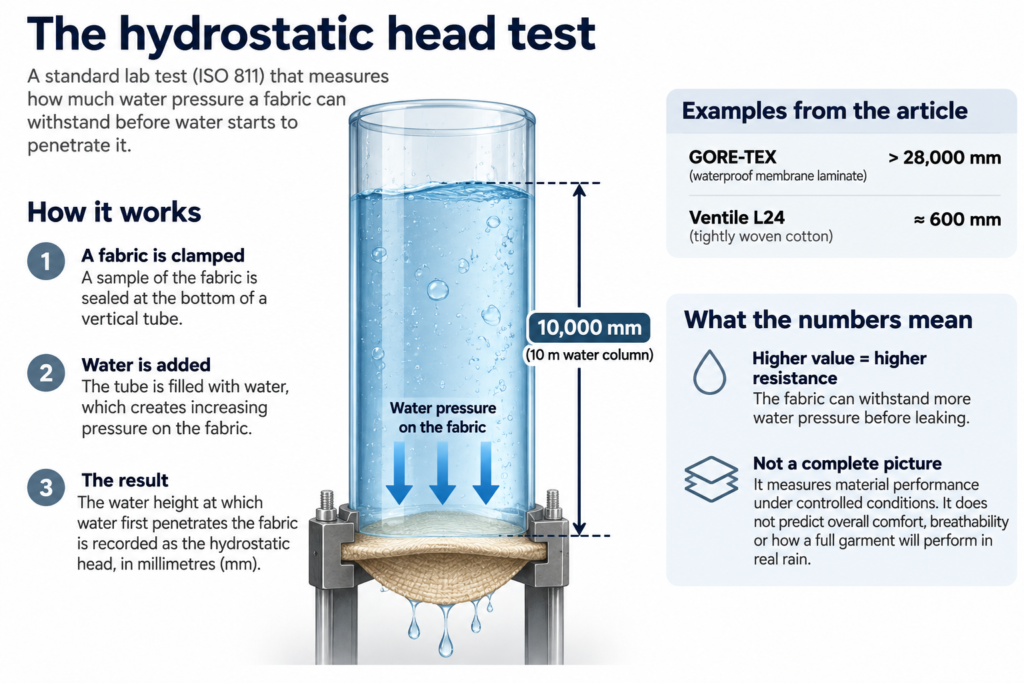
Imagine a piece of fabric stretched across the bottom of a vertical tube.
Water is gradually added, increasing the pressure against the material. Eventually, water begins to penetrate.
This is the principle behind the hydrostatic head test, described in ISO 811.
The result is expressed in millimetres of water column.
A rating of 10,000 mm means that the material resists pressure equivalent to a ten-metre column of water under the specified test conditions. A rating of 20,000 mm represents twice that pressure.
The higher the figure, the greater the measured resistance to water penetration.
Consider two examples.
Gore states that its GORE-TEX laminates meet an internal waterproofing requirement exceeding 28,000 mm.
A technical specification from Ventile lists 600 mm for its classic L24 cotton fabric.
That is a dramatic difference.
Yet it would be meaningless to conclude that the Gore laminate provides nearly 47 times as much protection in ordinary rain, let alone 47 times as much comfort.
A hydrostatic head test measures one particular property under controlled conditions. It does not tell us how warm, comfortable or sweaty we will feel inside a garment.
And a fabric is not a jacket.
Water may enter through seams, openings or damaged sections. The pressure created by kneeling on wet ground or by a loaded rucksack can place additional demands on materials. Movement, repeated flexing and wear can also influence performance.
A fully waterproof garment must address all these potential routes for water to enter.
Waterproof versus water-repellent
Another distinction matters just as much.
When water forms droplets on a fabric and rolls away, we call the surface water-repellent.
But water repellency does not necessarily mean that water cannot penetrate the fabric under pressure.
The distinction is formalised in two different standards.
ISO 811 measures resistance to water penetration. ISO 4920 measures resistance to surface wetting through a spray test. The latter does not predict resistance to rain penetration.
Most modern waterproof membrane jackets combine both properties.
Their membrane provides the primary waterproof barrier. An additional durable water-repellent finish, usually called DWR, helps prevent the outer textile from becoming saturated.
When this treatment deteriorates, rain may soak into the outer fabric. The garment becomes heavier and can feel cold or clammy.
This is known as wetting out.
Crucially, a jacket can wet out while its membrane remains completely waterproof.
Restoring the DWR can improve comfort, but it does not repair a damaged membrane.
Waterproofness and water repellency are related, but they solve different problems.
Breathability: can clothing really breathe?
The term breathable suggests something wonderfully simple: perspiration leaves the garment while rain stays outside.
Unfortunately, human physiology is not quite so accommodating.
Our bodies release moisture continuously, and sweat production increases dramatically during exercise.
For evaporation to cool us effectively, moisture and heat must escape from the space next to our skin.
This depends on several factors: the clothing material, temperature, surrounding humidity, airflow and the amount of moisture being produced.
Two measurements commonly appear in technical clothing specifications.
MVTR — Moisture Vapour Transmission Rate
Usually expressed in g/m²/24 h, MVTR measures the quantity of water vapour transmitted through a material over a given period.
A higher figure indicates more vapour transport under the particular test conditions.
RET — Resistance to Evaporative Heat Transfer
RET measures the resistance a material offers to evaporative heat transfer. Lower values indicate less resistance.
The method is described in ISO 11092, which uses a heated test plate to simulate some of the processes occurring near human skin.
These measurements are not directly interchangeable.
Furthermore, different MVTR methods can produce substantially different results for the same material. Comparing two quoted figures without knowing the testing procedures can therefore be misleading.
There is a revealing detail in the latest edition of ISO 11092, published in May 2026.
The standard explicitly states that its test conditions are not intended to represent specific comfort situations.
In other words, laboratory breathability measurements provide useful information about materials, but they cannot predict precisely how comfortable someone will be during a wet mountain walk.
Why a breathable jacket can feel clammy
Moisture vapour transport generally depends on differences in vapour pressure.
When the air inside clothing is warm and humid and the surrounding air has a lower vapour pressure, moisture can move outwards.
But when the environment is very humid, the driving force may be reduced. Low temperatures can also encourage condensation within a clothing system.
And during strenuous exercise, sweat production may exceed the clothing’s capacity to remove moisture.
Even an excellent membrane cannot guarantee that a person will remain dry under every condition.
Another property is often overlooked: air permeability.
A material may allow moisture vapour to pass while permitting little actual airflow.
Many waterproof membranes are designed to prevent wind from penetrating. This is valuable for warmth, but it also means that ventilation through the fabric itself may be limited.
The wearer must rely on other mechanisms to release excess heat.
Underarm zips, adjustable cuffs, loose collars and front openings can make an enormous difference.
A breathable fabric and a well-ventilated garment are not necessarily the same thing.
Your jacket is only one part of the system
There is another piece of the puzzle, often overlooked in discussions about waterproof clothing.
What are you wearing underneath?
Imagine an excellent waterproof shell over a cotton T-shirt that has absorbed a substantial amount of sweat.
The shell may still be transporting water vapour effectively. But the cotton can retain liquid moisture against the skin and take considerable time to dry.
The result may feel exactly like a leaking jacket.
This has led to a familiar piece of outdoor advice: never wear cotton underneath breathable waterproof clothing.
There is some truth behind it, but the absolute rule is misleading.
A cotton shirt does not prevent a breathable membrane from breathing. It changes how the entire clothing system manages moisture.
Cotton can absorb considerable amounts of water. That can initially reduce the sensation of dampness, but when saturated, the fabric may remain wet for a long time.
Some synthetic fabrics absorb less water into their fibres and can dry more quickly. Wool behaves differently again, absorbing moisture vapour while retaining useful insulating properties under certain conditions.
However, fibre composition alone does not determine performance. Fabric construction, thickness, fit and finishing all matter.
The relevant questions are how quickly moisture moves away from the skin, how much the fabric retains, how easily it dries and how it interacts with the outer layers.

Directional base layers
Páramo provides an interesting example of designing layers to work together.
Its Parameta range includes fabrics engineered to move perspiration and regulate the relationship between cooling and insulation.
Parameta G uses a raised grid construction that traps warm air when covered by a windproof layer but allows greater cooling when exposed.
Parameta T and T+ use different fabric faces to influence moisture movement and the sensation of cooling.
These materials can complement Páramo’s directional outerwear, although compatible clothing need not necessarily come from the same manufacturer.
Buffalo takes an almost opposite approach to layering.
Its classic Double P garments are designed to be worn directly against the skin. The pile lining itself performs the moisture-management function normally associated with a separate base layer.
Adding an ordinary shirt underneath can interfere with the way the system is intended to operate.
Neither approach is universally superior. They simply demonstrate that the relationship between layers is part of the design.
A jacket’s breathability figure cannot describe everything happening beneath it.

Different ways to deal with rain
There is no single technological route to weather protection.
Some systems create a physical barrier. Others make the fabric resistant to wetting, transport moisture away from the body or use garment design to avoid trapping humid air.
The following table compares the main approaches.
Comparison: waterproofness and breathability
| Approach | Examples | Rain protection | Moisture management and comfort |
|---|---|---|---|
| Waterproof membranes | GORE-TEX, Sympatex, eVent, Pertex Shield | Generally high resistance to sustained rain and water pressure | Engineered water-vapour transport; limited or variable air permeability |
| Breathable waterproof coatings | The North Face DryVent, PU-based HydroDRY constructions | Can provide high water resistance | Microporous or hydrophilic coatings transport water vapour, with performance depending on construction |
| Low-breathability waterproof coatings | Conventional PVC, silicone and some PU coatings | Can provide excellent waterproofness | Little vapour transport through the material; comfort depends heavily on garment ventilation |
| Tightly woven weather-resistant textiles | Ventile, etaProof, Grenfell Cloth | Resist rain but generally have lower hydrostatic head ratings than waterproof membranes | Vapour and air transport depend on weave, finish and wetness |
| Waxed or impregnated woven fabrics | G-1000, traditional waxed cotton | Adjustable water resistance, not normally intended as a high-pressure waterproof barrier | Air permeability generally decreases with heavier treatment |
| Non-membrane softshells | Tightly woven synthetic softshells | Usually suitable for light rain and showers | Often good air permeability and moisture release |
| Moisture-managing systems | Buffalo Double P, Montane Extreme, Páramo Nikwax Analogy | Varies greatly: from weather-resistant pile systems to directional waterproof garments | Combines textile structure, moisture transport, insulation and ventilation |
| Ventilation-first protection | Ponchos, umbrellas, rain kilts | Depends on coverage and wind rather than fabric alone | Potentially excellent ventilation even with completely impermeable fabrics |
These are comparisons of design principles, not results from a controlled test of equivalent garments. Categories can overlap, and no universal RET or MVTR ranking is possible without comparable measurements.
Waterproof membranes: keeping liquid water out
The modern waterproof shell is arguably the most familiar approach.
A thin membrane is incorporated into a textile laminate, commonly with an outer face fabric and a protective inner layer.
The membrane prevents liquid water from penetrating while permitting moisture vapour transport.
But not all membranes work in the same way.
Microporous membranes use structures containing extremely small pores. These resist liquid water penetration while allowing water vapour to move through.
Other membranes are hydrophilic and non-porous, transporting moisture through interactions with the polymer itself.
The original GORE-TEX technology became famous for expanded PTFE, or ePTFE. Modern GORE-TEX products also use expanded polyethylene, known as ePE.
Sympatex takes a different route, using a non-porous polyether-ester membrane.
eVent is associated with Direct Venting, a technology developed to allow moisture transport with some air permeability through its microporous construction.
Pertex Shield covers a range of waterproof membrane technologies, including variants with differing approaches to air permeability.
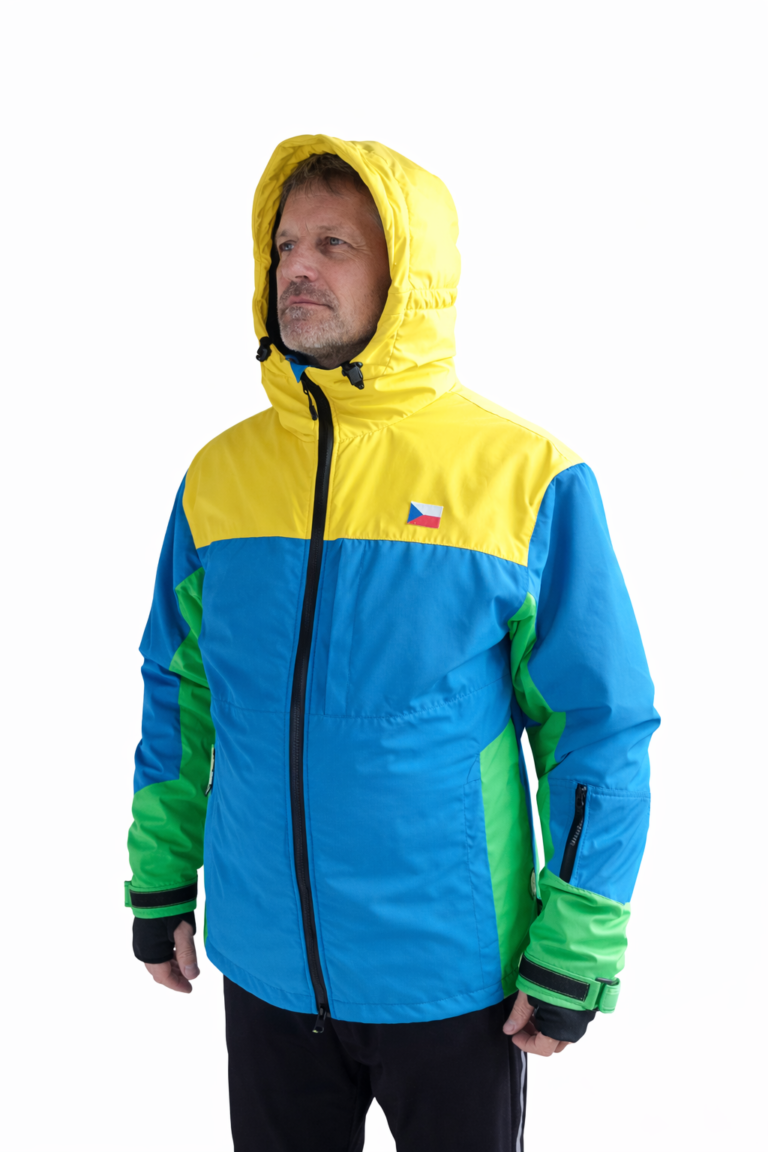
Smaller manufacturers contribute their own developments. Czech clothing maker Faramugo, for example, uses nanofibre membrane technology in technical outdoor garments.
These examples underline an important point: a membrane is a category of technology, not a single material with one fixed level of breathability.
The great advantage of a well-designed membrane shell remains its reliable barrier against prolonged rain, including conditions involving pressure.
Its limitation is that the entire clothing system must still manage heat and moisture generated inside.
Breathable coatings: not all coatings are plastic barriers
The word coating may bring to mind a heavy, rubbery raincoat that blocks everything — rain, wind and perspiration.
Such fabrics certainly exist.
But modern coatings can be much more sophisticated.
Some are microporous, containing tiny pathways that permit moisture vapour transport while resisting liquid water.
Others are hydrophilic. These coatings may have no pores at all, yet allow water vapour to move through the polymer.
The North Face’s DryVent is a useful example. The company describes it as a waterproof, breathable technology using a polyurethane coating.
Sprayway’s HydroDRY family includes hydrophilic PU-based constructions. Its HydroDRY AWP specification quotes a minimum hydrostatic head of 20,000 mm and an MVTR of 20,000 g/m²/24 h, although the latter figure cannot be compared fairly with other brands without knowing the test method.
Coatings can therefore deliver performance that overlaps substantially with membrane laminates.
The distinction is partly one of construction: a coating is applied to a textile, while a membrane is generally a separate film or structure laminated to other materials.
Patagonia’s H₂No is worth mentioning here because it is often mistaken for a specific waterproof material. It is actually a performance standard covering water resistance, breathability, surface repellency and durability.
In practice, the terms coating, membrane and laminate are sometimes used inconsistently in product descriptions, and a garment can incorporate more than one of them.
Low-breathability coatings: waterproof, but not necessarily uncomfortable
Other coatings prioritise an impermeable barrier.
Conventional PVC-coated textiles, silicone-coated fabrics and certain polyurethane coatings can resist water extremely well while allowing little water vapour through.
In a close-fitting rain jacket, this can create substantial condensation during exercise.
But the same fabric used in a loose poncho may be surprisingly comfortable.
That apparent contradiction becomes important later.
It demonstrates that the permeability of a fabric and the ventilation of a garment are separate questions.
Tightly woven fabrics: resisting rain without a membrane
Long before modern membranes, textile manufacturers were developing methods of making fabrics resistant to rain through their structure.
Classic Ventile is an interesting example.
Its finely spun cotton yarns are woven exceptionally tightly. When moisture reaches the fibres, they swell, reducing the small gaps within the fabric and helping resist further penetration.
Ventile is a brand, however, not the general name for this approach.
The closely related etaProof fabrics, produced by Swiss textile manufacturer Stotz, share much of the same technical heritage. British Grenfell Cloth represents another tradition of densely woven, weather-resistant cotton.
These fabrics can offer useful protection from rain and wind without a separate waterproof membrane.
They also have limitations.
Cotton absorbs moisture, becomes heavier when wet and can dry relatively slowly. Its airflow and vapour transport characteristics change with moisture content, and prolonged water pressure may eventually cause penetration.
The absence of a membrane does not automatically make these fabrics more breathable than every membrane alternative.
Their attraction lies in a particular balance of weather resistance, fabric feel, construction and potential longevity.
Waxed fabrics: protection that can be adjusted
Another approach takes a woven textile and modifies its water resistance with wax or other impregnating treatments.
Traditional waxed cotton has a long history in European clothing manufacture.
Scottish textile specialist Halley Stevensons still develops and finishes waxed cotton fabrics in Dundee, while British Millerain is another established name in this field.
Fjällräven’s G-1000 is a contemporary example, using a fabric containing 65% polyester and 35% cotton.
By applying Greenland Wax, made from beeswax and paraffin, users can increase its resistance to water and wind. Washing can remove some of the wax and produce a lighter, airier material.
This adjustability is particularly interesting.
Rather than making a permanent choice between maximum protection and maximum ventilation, users can modify the fabric according to their needs.
But the compromise remains. Additional wax can reduce air permeability, and G-1000 is described by its manufacturer as water-resistant rather than waterproof.
In sustained heavy rain, a separate waterproof layer may still be necessary.
Softshells: accepting a little weather
Not every outdoor garment needs to resist hours of rain.
Softshell clothing often prioritises wind resistance, flexibility, moisture transport and comfort during movement.
The most relevant examples here are non-membrane woven softshells, which may allow considerably more airflow than conventional waterproof shells.
During active walking in cool, windy conditions with occasional showers, that can be a useful compromise.
But the term softshell is not a precise technical classification.
Some softshells incorporate membranes or substantial coatings. Others rely almost entirely on their weave and water-repellent finish.
Their value depends on recognising where weather resistance is sufficient — and where proper waterproof protection becomes necessary.
Managing moisture rather than excluding every drop
Perhaps the most interesting alternatives are clothing systems that place moisture management at the centre of their design.
Two distinct approaches deserve attention.
Pertex-and-pile systems
Buffalo’s Double P construction combines a wind-resistant Pertex outer fabric with a pile lining designed to be worn against the skin.
The outer fabric sheds some rain and reduces wind exposure. The pile provides insulation and manages moisture, helping preserve warmth even when parts of the system become wet.
The concept depends partly on continued heat production by the wearer.
Buffalo explicitly states that its products are not waterproof. It also acknowledges that heavy rain or reduced activity may require additional protection.
Montane’s Extreme range follows a related Pertex-and-pile philosophy, although individual garments can include additional waterproof reinforcement panels.
These are not simply rain shells. Insulation and moisture management form an integral part of the garment.
This can be effective in cold conditions involving sustained activity, but it is not automatically appropriate for warm weather or extended inactivity.
Directional waterproof systems
Páramo’s Nikwax Analogy takes a different approach.
Its construction combines a water-repellent outer textile with a specially designed inner layer intended to transport liquid moisture away from the body.
Rather than relying exclusively on vapour passing through a membrane, the system uses directional liquid transport as part of its protection strategy.
Páramo describes this as a waterproof system.
According to its published procedure, prototype garments are tested in the University of Leeds rain room. They are exposed to simulated rain at 15 mm per hour for at least four hours.
This is a fundamentally different assessment from a hydrostatic head test.
One measures the resistance of material to pressure. The other evaluates the performance of a complete garment under simulated rain.
Neither tells the whole story, and the two results cannot simply be converted into one another.
Páramo’s system has its own compromises, including garment weight, warmth, maintenance requirements and suitability for different temperatures.
It does, however, demonstrate that a waterproof clothing system need not depend on a conventional membrane.
What if the fabric doesn’t need to breathe?
There is an almost comically simple solution to the problem of trapped perspiration.
Do not trap it in the first place.
Consider an umbrella.
The umbrella fabric might be completely impermeable to both water and water vapour.
Yet the air around the person remains largely unobstructed.
Warm, humid air can move away freely. Evaporation is not restricted by a close-fitting waterproof layer over the upper body.
The umbrella does not need to be breathable because it does not enclose the body.
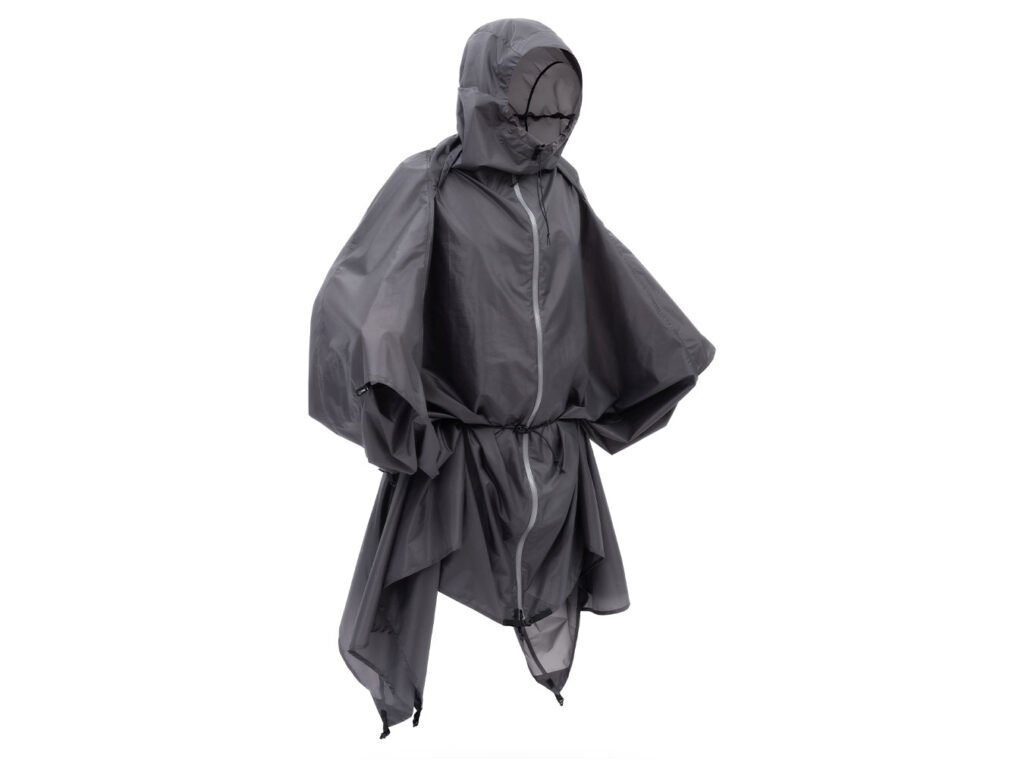
A poncho follows a related principle.
It may be made from an impermeable fabric, but its loose shape allows air movement around the torso. Some designs also cover a rucksack, eliminating the need for a separate pack cover.
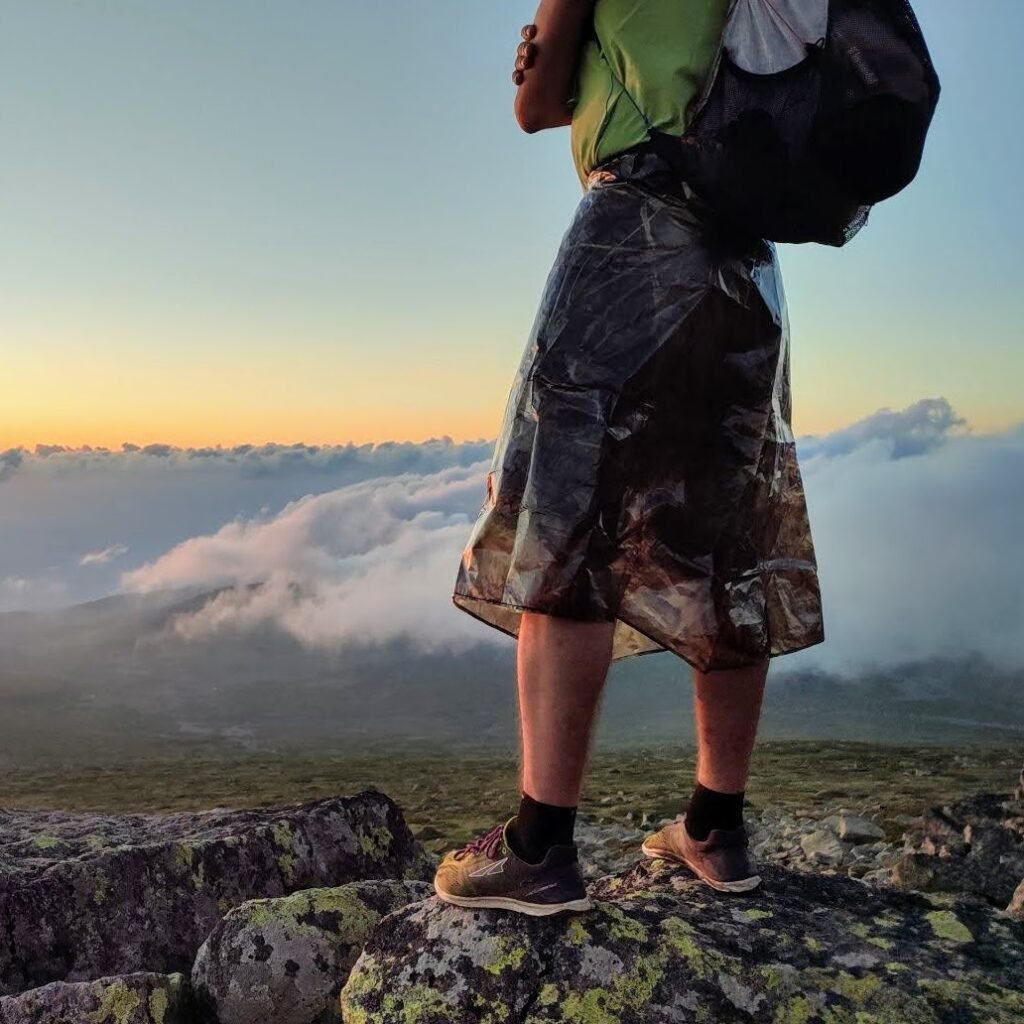
A rain kilt extends the idea to the legs.
Instead of waterproof trousers enclosing both legs, a skirt-like sheet protects the upper legs while leaving considerably more room for ventilation.
These solutions have obvious limitations.
Wind can make umbrellas impractical. A poncho may flap, restrict visibility or allow driving rain to enter from the sides. A rain kilt provides incomplete coverage, particularly below the knees.
They are not necessarily suitable for exposed ridges, technical climbing or all winter conditions.
But they expose a weakness in how we talk about breathability.
The most effective way to release warm, humid air may have very little to do with the permeability of the fabric.
Garment design can sometimes matter more than fabric specifications.

The environmental price of staying dry
Weather protection is not only a performance question.
It also involves the chemistry of materials, resource consumption, product longevity and what happens when clothing can no longer be used.
The environmental debate has often focused on PFAS, but the issue extends beyond any single chemical family.
Are waterproof membranes made from PFAS?
Some are. Others are not.
PFAS stands for per- and polyfluoroalkyl substances, a broad family of chemicals characterised by particular carbon-fluorine structures.
Many PFAS are extremely persistent in the environment, and some have well-established adverse environmental or health effects.
Historically, outdoor clothing has used fluorinated chemistry in at least two distinct ways.
The first is in waterproof membrane materials, particularly expanded polytetrafluoroethylene, or ePTFE. PTFE is a fluoropolymer included within broad structural definitions of PFAS.
The second is in durable water-repellent treatments applied to outer textiles.
These are separate components.
A jacket could have a fluorine-free surface treatment and still contain an ePTFE membrane.
Conversely, a membrane manufactured without PFAS could be combined with a different surface treatment, depending on the product specification.
It is therefore important to evaluate the complete garment rather than rely on a single marketing label.
The industry is changing
Gore’s newer ePE membranes use expanded polyethylene instead of ePTFE.
The company describes these as manufactured without intentionally added PFAS, while acknowledging the possibility of trace amounts.
Sympatex uses a PFAS-free polyester-based membrane and has developed laminate constructions using polyester outer and lining fabrics.
Patagonia states that all its new products since spring 2025 have been made without intentionally added PFAS, including products with waterproof membranes and water-repellent finishes.
Páramo’s Nikwax Analogy system does not rely on a conventional fluoropolymer membrane. Nikwax states that its treatment products have never contained PFAS.
These developments demonstrate that high-performance rain protection no longer necessarily requires fluorinated membranes or treatments.
However, PFAS-free does not mean impact-free.
Synthetic polymers still require resources and energy to manufacture. Finishing, dyeing, adhesives and other components contribute to the garment’s overall environmental footprint.
Nor should every fluoropolymer be treated as though it has identical toxicological properties. Chemical identity, potential emissions, exposure pathways and environmental persistence all matter.
The European Environment Agency identifies PFAS-containing textiles as a problem for circularity because of contamination risks during reuse and recycling.
Avoiding persistent chemicals is important, but it is only part of a much larger picture.
Natural versus synthetic: no automatic winner
Classic Ventile has a relatively simple material structure: tightly woven cotton without a conventional waterproof laminate.
That can offer advantages in repair and end-of-life processing.
But cotton cultivation requires agricultural land and water, with impacts that depend heavily on farming methods and location.
Waxed cotton can incorporate paraffin, a petroleum-derived material.
G-1000 is a blend of cotton and polyester, creating different recycling challenges from a single-fibre textile.
Buffalo and Montane pile systems use synthetic fibres, which can shed microplastics during manufacturing, wearing and washing.
Páramo uses synthetic textiles too, even though it avoids the conventional waterproof membrane construction.
None of these approaches becomes environmentally superior merely because it is traditional, natural, membrane-free or technologically sophisticated.
A meaningful comparison must consider the complete product, how long it remains useful and the environmental consequences throughout its life.

Repairability and recycling: how long can the protection last?
Recycling is important, but it should not distract from a simpler question.
Can the garment be repaired?
A membrane jacket is not necessarily difficult to repair.
Small tears can often be patched. Zips can be replaced. Damaged stitching and some seam tape failures may be repairable.
Regular cleaning and suitable water-repellent treatments can also restore performance that might otherwise be mistaken for permanent deterioration.
But one problem is particularly troublesome: delamination.
This occurs when layers of a laminate separate from one another.
If the separation is extensive, repairing the affected area may be technically difficult or economically impractical.
Patagonia, which operates an established repair service, explicitly lists some cases of peeling internal laminate among the damage it cannot repair.
A conventional tightly woven fabric does not have that particular failure mode because no waterproof membrane is bonded to it.
Waxed fabrics can often be patched and reproofed.
Buffalo offers a repair service intended to keep older garments in use.
Páramo likewise supports repairs, refurbishment and a take-back scheme for used garments.
These are practical differences that can matter far more than a theoretical claim about recycling.
The recycling problem
Waterproof laminates often combine several different materials.
A typical three-layer jacket may contain polyester or nylon, a membrane of another polymer, adhesives, seam tape and various smaller components.
Separating these materials into useful recycling streams is challenging.
However, not all laminates are equally difficult to recycle.
Sympatex has developed constructions in which its polyester-based membrane is combined with polyester outer and lining textiles. This reduces the complexity associated with mixed-polymer laminates.
Páramo similarly highlights the use of polyester in its Analogy fabric system and operates a garment collection programme.
These are promising approaches.
But a technically recyclable material is not the same as a garment that is actually recycled.
Collection, sorting, accessories, processing technology and economic viability all determine whether a closed loop exists in practice.
A company offering a recycling programme provides a meaningful route for garments to be returned. The environmental result still depends on what happens to those garments.
Environmental comparison
| Approach | Main environmental considerations | Repairability | Recycling challenges |
|---|---|---|---|
| Membrane laminates | Polymer production, adhesives, DWR; older ePTFE contains fluoropolymers, newer ePE options avoid intentionally added PFAS | Tears, seams and zips can often be repaired; extensive delamination is difficult | Mixed bonded layers are challenging; mono-material constructions may improve prospects |
| Breathable PU coatings | Polymer chemistry, finishing and potential degradation | Tears may be patched; degraded or peeling coatings are difficult to restore | Coating may hinder recovery of the underlying textile |
| Low-breathability coatings | PVC, silicone or other polymers; impacts depend on chemistry | Holes can be patched, but coating deterioration may be irreversible | Coated textiles can be difficult to process into clean fibre streams |
| Tightly woven cotton | Cotton cultivation, water use, dyeing and finishing | Conventional stitching and patching generally possible; no membrane delamination | Simpler fibre composition, although finishes and components complicate recycling |
| Waxed woven fabrics | Wax chemistry, including possible petroleum-derived ingredients; natural or blended fibres | Rewaxing and patching are generally practical | Wax finishes and fibre blends may complicate recycling |
| Non-membrane softshells | Synthetic fibres, possible DWR and microfibre release | Often straightforward to patch or sew | Fibre blends and elastane can be problematic |
| Pertex-and-pile systems | Synthetic fibres, possible microplastic release, product-specific DWR | Panels, seams and zips can often be repaired | Different synthetic fibres and components may need separation |
| Directional systems | Synthetic textiles, treatments and manufacturing impacts; Nikwax treatments are PFAS-free | Repair and reproofing are supported by manufacturers such as Páramo | Polyester construction offers recycling potential, but actual outcomes depend on processing |
| Ponchos, umbrellas and rain kilts | Highly dependent on materials, coatings and product construction | Simple fabric products often patchable; umbrella frames vary | Simple designs may help, but coatings and mixed components still matter |
This is a qualitative assessment of materials, construction and potential end-of-life issues. It is not a life-cycle assessment. No approach can be declared universally the most sustainable without comparing complete products over equivalent useful lifetimes.
What actually works in the rain?
There is no universal answer, because the conditions continually change.
Consider four situations.
Walking hard in cool, intermittent rain
During strenuous activity, heat and moisture management may dominate the experience.
A lightweight waterproof shell can provide excellent protection, especially with effective ventilation openings.
A non-membrane softshell, directional garment or Pertex-and-pile system may also offer advantages, depending on temperature and the amount of moisture generated.
A poncho or umbrella can provide considerable ventilation when wind conditions allow.
Here, the highest water-column rating is not necessarily the most useful specification.
Several hours of heavy rain with a loaded rucksack
Resistance to external water becomes more demanding.
A properly constructed waterproof membrane shell provides strong protection, particularly where pressure, wind and repeated wetting are involved.
Páramo’s directional waterproof clothing is another approach designed and tested for prolonged rain.
Classic Ventile, waxed textiles and non-waterproof pile systems have different limitations and may eventually allow external water to penetrate.
The choice also depends on insulation, fit, ventilation and the clothing worn underneath.
Standing still in cold rain
Once movement stops, heat production falls.
A clothing system that worked comfortably during an energetic climb may no longer provide sufficient warmth.
Wet or saturated materials may increase the risk of cooling, especially in wind.
Reliable outer protection and sufficient insulation become increasingly important.
Buffalo’s own guidance acknowledges that its system may need additional protection when activity is reduced or rain is particularly heavy.
No system can eliminate the importance of carrying clothing appropriate for periods of inactivity.
Walking in warm, humid weather
This is particularly difficult for clothing that encloses the body.
The conditions driving evaporation may be unfavourable, and perspiration can accumulate even inside technically breathable garments.
Insulated systems such as heavy pile clothing may be entirely unsuitable.
In appropriate terrain, a poncho, umbrella or highly ventilated lightweight shell may offer a better balance.
It is a reminder that protection should be designed around the activity and environment, not simply around the worst imaginable rainfall.
Beyond waterproof
The development of waterproof membranes was an extraordinary achievement in textile engineering.
It made it possible to manufacture lightweight clothing that combines strong resistance to liquid water with measurable moisture vapour transport.
But it did not make every other approach obsolete.
Tightly woven cotton continues to offer a distinctive form of weather protection. Waxed fabrics allow their surface properties to be renewed and adjusted. Non-membrane softshells favour airflow and comfort in less severe conditions.
Pertex-and-pile systems illustrate how insulation and moisture management can work together. Directional textiles take another approach to handling liquid water. Even ponchos and umbrellas show that a garment’s shape can be as relevant as its material.
All have limitations. All make compromises.
The environmental comparison is equally nuanced. Newer waterproof membranes can avoid PFAS, while traditionally made fabrics are not automatically sustainable. Repairability, service life and actual recycling systems deserve as much attention as material composition.
A useful waterproof rating tells us how well a fabric resists water pressure.
A useful breathability rating tells us something about moisture transport under defined laboratory conditions.
Neither can tell us, on its own, what it will feel like to walk for six hours in the rain.
Perhaps the most important question is not simply whether the clothing is waterproof.
It is whether the complete clothing system can manage the rain outside, the moisture inside and the changing needs of the person wearing it.
Staying comfortable in the rain is not just about keeping water out. It is about managing water, heat and air — and knowing which compromises matter when conditions change.





One Comment
Comments are closed.