Understanding down insulation
Fill power, origin, moisture and long-term care in sleeping bags and insulated jackets
A sleeping bag filled with 900-fill-power down is not necessarily warmer than one filled with 700-fill-power down. Goose down is not automatically better than duck down. A sleeping bag made in Europe does not necessarily contain European down. And even the familiar rule that synthetic insulation “keeps you warm when wet” is much less straightforward than it sounds.
Down is an unusual insulation material. High-quality down combines very low weight with high loft and excellent compressibility, and a well-made down sleeping bag can remain useful for decades. But down is also an animal-derived material with questions around traceability and animal welfare. Its quality is often reduced to a single number — fill power — even though that number depends on how the material is sampled, conditioned and tested.
Understanding down therefore means looking beyond the number on the label.
What is down?
Down and feathers are not the same thing.
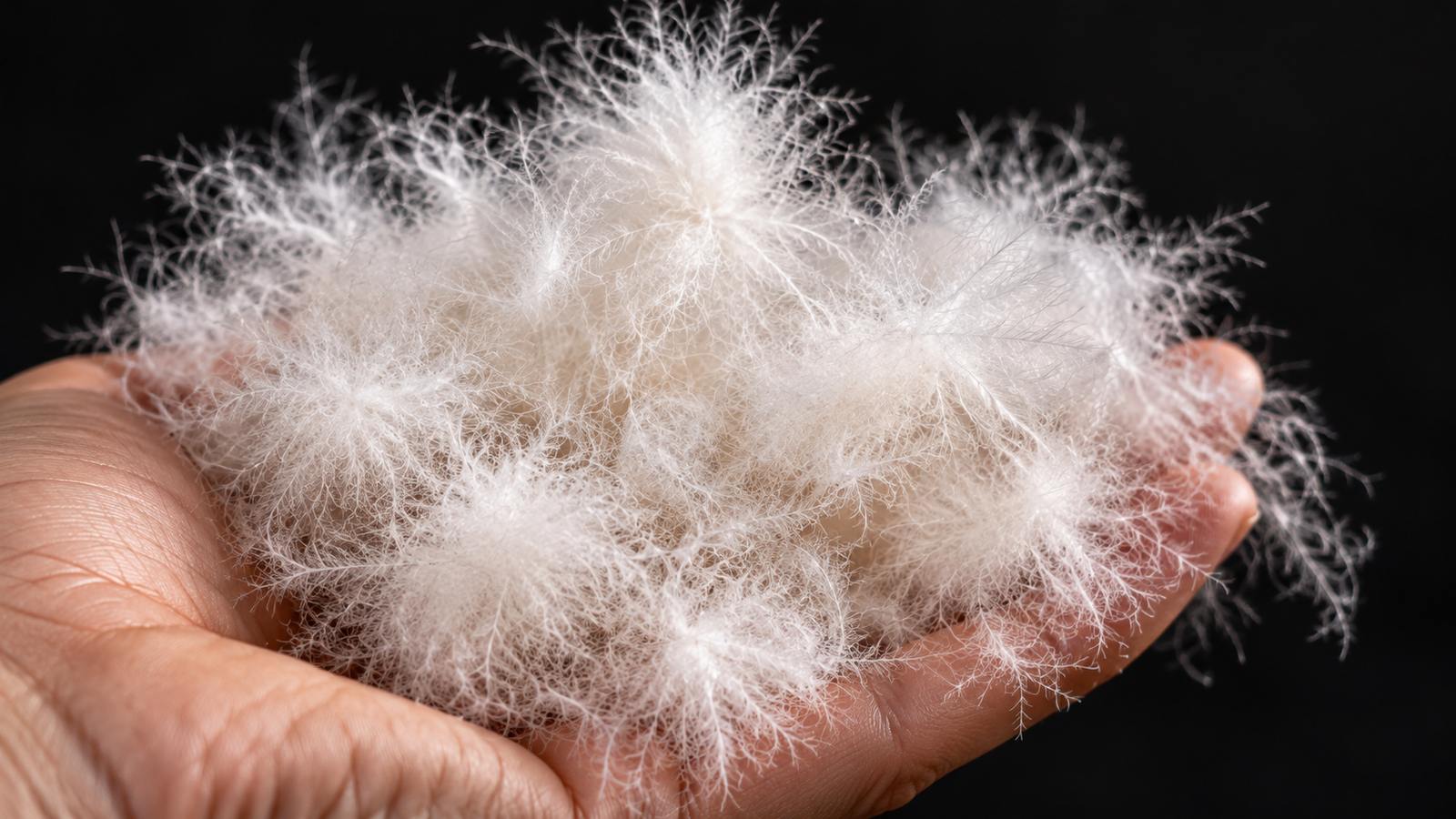
A conventional feather has a central shaft, or quill, from which barbs extend. A down cluster has no comparable long, rigid central shaft. Instead, it consists of a three-dimensional structure of very fine barbs and barbules extending from a small core.
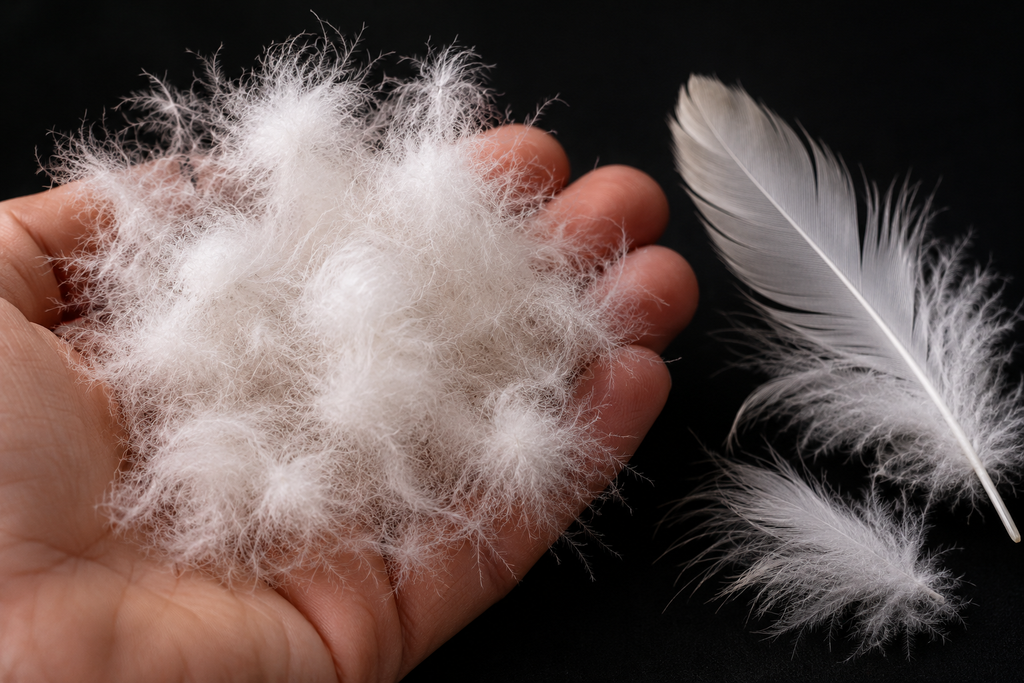
That structure traps air. And it is primarily this trapped, relatively still air — rather than the keratin material itself — that provides thermal insulation.
This explains two of down’s most useful characteristics for outdoor equipment: it can create a large insulating volume from a relatively small mass, and that volume can be compressed dramatically for transport.
The ratio sometimes stated as, for example, 90/10 or 95/5 describes the composition of the filling — broadly, down versus feather components. It does not describe fill power. Composition and fill power are related characteristics, but they are not interchangeable.
Duck, goose — and eider
Most down used in outdoor clothing and sleeping bags comes from ducks or geese. Goose down tends, on average, to contain larger clusters and can therefore more readily reach very high fill powers. But species alone is a poor quality indicator: excellent duck down can outperform mediocre goose down. The International Down & Feather Laboratory and Institute (IDFL) explicitly warns against judging quality from species alone.
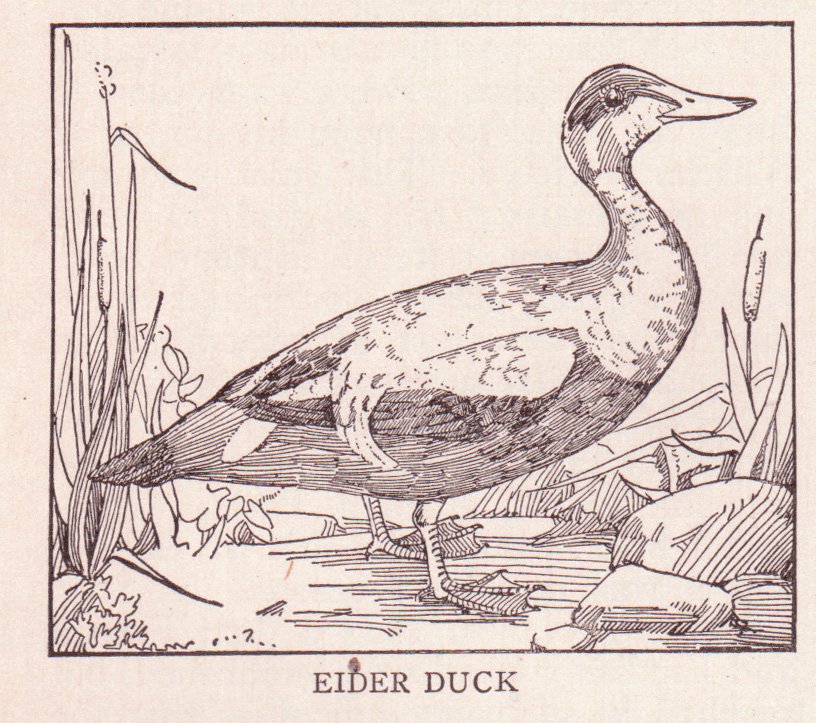
A rare exception is eiderdown, collected from the nests of common eiders rather than obtained in the same way as normal commercial duck or goose down. Eiderdown has been collected in Iceland for centuries. Research in Iceland has examined the effect of taking nest down during incubation and suggests that delaying collection until late in incubation minimises potential disturbance. It is an interesting material, but a niche one and not representative of ordinary down sleeping bags. 1
Fill power is not warmth
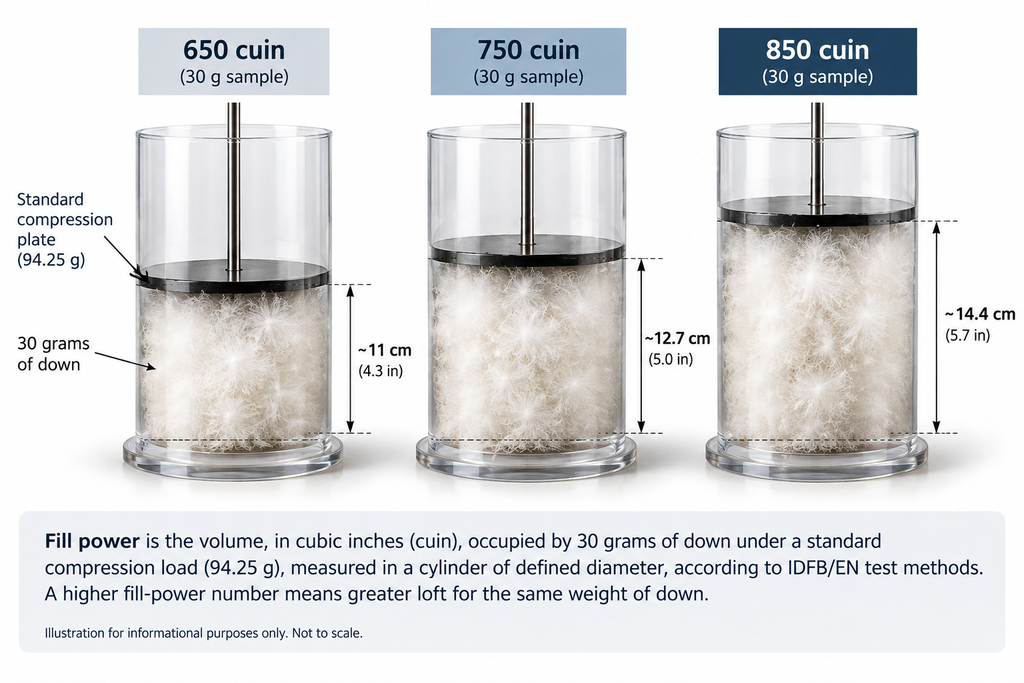
Fill power describes how much volume a specified mass of down occupies under a defined test procedure and compression load.
It is therefore better understood as a measure of the lofting efficiency of the loose filling than as a direct measure of warmth.
This distinction matters.
A sleeping bag containing 450 g of 700-fill-power down can be warmer than one containing 250 g of 900-fill-power down. The finished sleeping bag also depends on its dimensions, cut, baffle construction, distribution of down, hood, zip, draught collar, shell fabrics and other details.
A 2021 study by Yuying An, Guangbiao Xu and Hua Shen tested 24 down sleeping-bag samples and examined fill weight, fabric air permeability and filling rate. Of the factors examined, fill weight was the most important factor influencing thermal resistance.2
This is why fill power should not be confused with the temperature performance of the finished sleeping bag.
For adult sleeping bags intended for recreational use with a limit temperature of −20 °C or above, ISO 23537-1:2022, published by the International Organization for Standardization (ISO), provides test methods for assessing the thermal performance of the complete sleeping bag.3
In simple terms:
Fill power tells us something important about the down.
A temperature test tells us something about the sleeping bag.
For down jackets, comparison is more difficult because there is no equivalent universally used temperature-rating system. A jacket advertised as “900 fill power” tells us surprisingly little about its warmth if the manufacturer does not also disclose how much down it contains.
So what is 1,000+ fill-power down used for?
Down with a claimed fill power of around 1,000 or more is rare and expensive. Its main advantage is not that it magically creates warmer products. It allows designers to produce a given amount of loft from less down.
In theory, if two down qualities were measured using exactly the same method, 1,000-fill-power down would require only about 80% of the mass of 800-fill-power down to create the same measured fill volume. Real sleeping bags are more complicated than this simple calculation, but it illustrates why extremely high fill power is attractive when every gram matters.
That is also where we find it in practice.
British specialist PHD, for example, reserves its 1,000-fill-power goose down for its lightest K Series equipment, including ultralight sleeping bags, half-bags and clothing intended for racing, mountaineering and expedition use. Jack Wolfskin currently uses 1,000-fill-power down in an expedition jacket developed with polar explorer Eric Larsen.
These are manufacturer examples rather than independent proof that 1,000 fill power is “better”. They illustrate its most logical application: situations where maximum insulation for minimum filling weight and pack volume justifies the cost.
For an ordinary sleeping bag, the jump from 800 to 1,000 fill power may be much less important than adequate fill weight, a suitable cut and good construction.
Why fill-power figures are more complicated than they look
This is where things become particularly interesting.
Several different fill-power systems have existed, and differences have included not only conditioning but also sample mass, cylinder dimensions, compression plates and reporting units.
The International Down and Feather Bureau (IDFB) develops internationally used testing regulations for down and feather. It should not be confused with IDFL: IDFB develops and coordinates test methods; IDFL is a commercial independent laboratory, inspection and certification organisation that performs tests according to IDFB, EN, ISO, Chinese and other methods.
Historically, comparing a European and an American “800” was therefore not necessarily comparing like with like.
| System | Sample mass | Important difference |
| Historical US method | 1 oz = 28.4 g | Smaller US measuring cylinder |
| IDFB fill-power method4 | 30 g | Larger IDFB cylinder; steam conditioning is the official current method |
| Old EN 12130 method | 20 g | Different European procedure and conditioning |
| EN 12130:2018 | 30 g | Allows steam, tumble-dry or box conditioning |
The IDFB’s own testing regulations contain a particularly revealing historical note. The newer IDFB instrument has always used a larger cylinder and 30 g of material, whereas the old US system used a smaller cylinder and one ounce — 28.4 g.
IDFB found experimentally that one ounce in the old US cylinder produced approximately the same numerical result as 30 g in the newer, larger IDFB cylinder. For that reason, laboratories continued for years to report results in cubic inches per ounce — in³/oz — even though the actual IDFB test used 30 g.
IDFB now explicitly requires the tested mass to be stated as 30 g to avoid that ambiguity.
Europe adds another layer to the story.
The old EN 12130 method used a 20 g sample. EN 12130:2018 changed this to 30 g and introduced three permitted conditioning routes: Method A using steam, Method B using tumble drying and Method C using box conditioning.5
So the familiar idea that:
“European fill power is lower than American fill power”
contains some historical truth, but is no longer a reliable conversion rule.
Today, a meaningful fill-power claim should ideally tell us which test standard and which conditioning method were used.
Why conditioning matters
Down that has spent weeks compressed in a sleeping bag or transport sack will not immediately display the same loft as loose, freshly conditioned down.
Temperature, humidity, mechanical agitation and steam can help compressed clusters recover. Testing standards therefore define how material must be conditioned before measurement.
Under current IDFB Part 10-B, the official conditioning method for fill-power testing is steam conditioning. After conditioning, testing takes place in a controlled environment. The IDFB specifies a climate room at 20 ± 2 °C and 65 ± 4% relative humidity, with the sample allowed to reach a stable weight before the final measurement.
Stimulation of the down before a test is therefore not automatically “cheating”. Conditioning is part of a standardised test.
The relevant question is whether two numbers were obtained under genuinely comparable procedures.
A Tatteljee experience
Peter Jongelen from Tatteljee told InEurope about having one batch of down tested by two different organisations, one of them in Germany. According to his recollection, down measured at approximately 700 fill power by one laboratory reached around 800 in the other.
We have not seen the original laboratory reports, so we cannot determine what caused the difference.
Peter suspected differences in conditioning and warned against treating fill-power numbers as absolute values. That explanation remains a hypothesis rather than a verified conclusion.
The wider warning, however, is well supported: sample selection, conditioning and testing procedure can influence the measurement, and old and current measurement systems are not identical.
Interestingly, Tatteljee’s archived material itself used the historical conversion “600 cuin = 800 Cuin USA” and “700+ = 900 Cuin USA”. That is useful evidence of how the market once communicated different systems, but it should not be used as a universal conversion formula today. 6
Down or synthetic insulation?
It is tempting to make a simple table in which down wins on weight and synthetic insulation wins in the wet.
That is useful as a first approximation — but only as an approximation.
There is no single “synthetic insulation”. Synthetic sleeping bags may use different polyester fibres, staple fibres, continuous structures, layered non-wovens and different bonding and construction systems. Down varies in cluster content, fill power, species, processing, treatment and quality.
A 2017 study comparing goose down, duck down and one high-bulk synthetic non-woven found significantly higher dry-state thermal resistance in the down test systems, while the non-woven showed lower water-vapour resistance. It was a comparison of specific materials under controlled conditions, not proof that every down insulation outperforms every synthetic one.7
A separate 2018 study compared goose down, duck down, two Thinsulate grades and polyester through repeated washing and dry-cleaning cycles and found different patterns of deterioration between the materials. Again, “synthetic” did not behave as one homogeneous category.8
A cautious general comparison looks like this:
| Characteristic | Down | Synthetic insulation |
| Warmth for weight | High-fill-power down can create a great deal of loft for little mass | Highly dependent on fibre and construction; usually heavier for comparable sleeping-bag performance |
| Pack volume | Excellent with high-quality down | Usually larger for equivalent warmth, but varies considerably |
| Heavy moisture exposure | Down clusters can collapse and lose much of their loft when saturated | Many synthetic structures retain more of their physical loft when wet |
| Drying | A saturated sleeping bag can take a long time and considerable tumbling to dry completely | Usually easier and faster to dry |
| Long-term loft | Good down can retain or regain useful loft for decades | Many synthetic fills gradually lose permanent loft through use and compression |
| Filling repair | Loose down can usually be redistributed, topped up or replaced | Replacing or topping up the insulation itself is extremely unusual |
| Shell/zip repairs | Usually possible | Usually possible |
| Animal origin | Relevant; requires consideration of welfare and traceability | No animal source, but brings different petrochemical, recycling and material questions |
| Cost | High-quality down is expensive | Very broad range, often cheaper |
The repair distinction deserves emphasis. A synthetic sleeping bag can certainly have its shell, seams, zip and other components repaired. But repairing degraded synthetic insulation itself is a different matter.
Mountain Equipment, for example, offers repairs to synthetic sleeping bags but describes the common repairs as zips, drawcords, seams and fabric damage. It also notes that most synthetic fillings progressively lose loft and warmth over time. Specialist retailer Alpinetrek states more directly that, unlike down, synthetic fills cannot normally be refilled or replaced.
There may be exceptional constructions where insulation could theoretically be dismantled and replaced, but refilling a synthetic sleeping bag is not a normal repair practice. For conventional down bags, it is.
That difference can become important over a product lifetime.
Wet down: another oversimplification
“Down does not work when wet” is broadly pointing towards a genuine weakness, but is too absolute.
As down absorbs enough moisture for its fine structures to stick together, the clusters collapse. The volume of trapped air decreases and thermal resistance falls.
Synthetic fibres generally absorb little water into the fibres themselves and many synthetic constructions retain more of their physical structure when wet. That gives them an advantage in situations with persistent moisture and limited opportunity to dry equipment.
But “synthetic keeps you warm when wet” should not be interpreted as “water has no effect on synthetic insulation”. Wet shell fabrics, water between fibres, compression and evaporative cooling still matter.
The useful distinction is therefore one of risk tolerance rather than absolutes.
For an environment where a sleeping bag may remain damp for days, a suitable synthetic system can offer a useful safety margin. Where the filling can be kept reasonably dry, high-quality down offers exceptional weight, volume and longevity advantages.
Where does down come from?
Most commercial down comes from ducks and geese raised primarily as food animals. The European Down and Feather Association (EDFA) describes down and feathers predominantly as a by-product of poultry meat production, although its quoted global percentage comes from a survey of its own members and should therefore be treated as industry data rather than independent statistics.
The geographical origin can vary considerably.
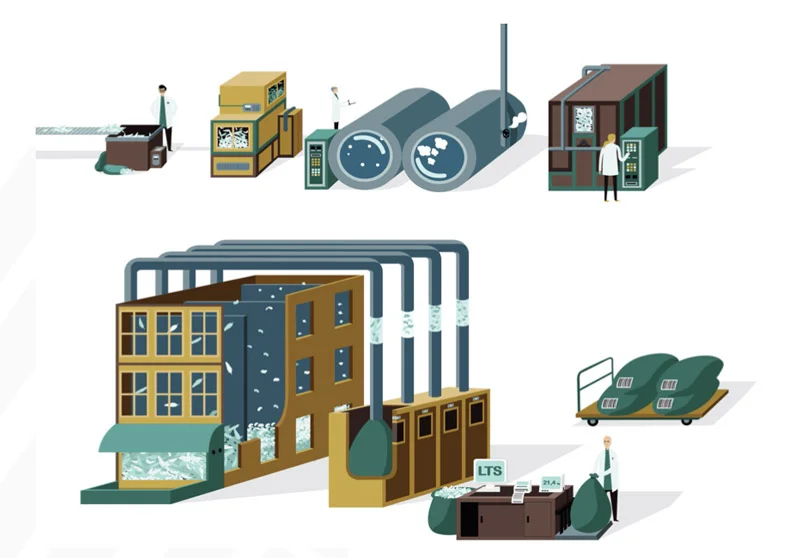
Down may originate in China, Poland, Hungary or many other countries, be washed or sorted in another country, and finally be filled into a sleeping bag somewhere else again.
None of those country names is a quality grade.
Is Chinese down less controlled?
Not necessarily.
China has an extensive standards system for down and feather. As of September 2026, GB/T 10288-2026 — Test method for down and feather is the current Chinese national test standard, replacing the 2016 version. It includes methods relating to composition, species identification, fill power, cleanliness, oxygen demand, residual fat, odour, pH and moisture. China also has GB/T 14272-2021 for down garments.9
The International Down and Feather Bureau lists certified testing laboratories in China alongside laboratories in other countries.
So “Chinese down is poorly controlled” is not a defensible general statement.
Nor would “European down is better controlled” be defensible without knowing the particular supply chain.
What matters is what can actually be established about the material: its composition, testing, processing, welfare controls and traceability.
And sometimes we simply do not know
A product may state “European goose down”, “Polish down” or another origin. But many products do not publicly state where the birds were raised.
That absence should not be filled with an assumption.
In the European Union, Regulation (EU) No 1007/2011 covers textile-fibre labelling but does not regulate country-of-origin labelling. For textile products within its scope it does require certain non-textile animal-origin components to be identified, but that statement still does not tell the consumer whether the down came from Poland, China or somewhere else.10
Outside the EU — including countries such as Switzerland and Albania — national rules can differ. Iceland participates in much EU/EEA legislation, but this does not justify presenting one EU labelling rule as a universal “European” rule.
For an international InEurope readership the safest rule is therefore simple:
If a manufacturer does not disclose the geographical origin of the down, and InEurope has no other reliable evidence, the origin is unknown.
Certification does not automatically solve that problem for the reader either. The Responsible Down Standard verifies a chain of custody, but Textile Exchange explicitly says the standard is not designed to provide consumers or brands with complete public identification of every farm in the supply chain.
Unknown should remain unknown.
Are birds killed for their down?
Usually, commercial down and feathers are obtained after slaughter as a by-product of poultry production. But historically and in some production systems, feathers have also been removed from living geese.
Here terminology matters.
The European Food Safety Authority (EFSA) distinguishes between gathering and plucking. 11
Gathering refers to removing mature feathers that have become loose as part of the natural moult. In principle, correctly gathering fully ripe feathers can occur without tissue damage.
Plucking means forcibly removing feathers that are not ready to be shed. EFSA describes bleeding follicles, skin tears, bruising and pain as possible consequences. It also concluded that under commercial conditions it cannot be assumed that all feathers collected from living birds are always sufficiently mature, and catching, handling and restraining birds can itself create welfare problems.
Historically, live geese could be subjected to this process more than once. A Food and Agriculture Organization of the United Nations (FAO) technical publication describes systems in which feather harvesting was timed at roughly six-week intervals and could occur several times in a season. The document describes production practice; it should not be interpreted as a current animal-welfare recommendation. 12
Modern welfare standards generally avoid this difficult distinction by prohibiting removal from live birds altogether.
What are RDS and DOWNPASS?
Two names appear repeatedly on down products: RDS and DOWNPASS.
They overlap, but are not identical.
Responsible Down Standard — RDS
The Responsible Down Standard (RDS) is a voluntary international certification standard owned by Textile Exchange.13
It covers animal-welfare criteria and chain of custody. Any removal of feathers or down from living birds — including collection during moulting — is prohibited. Force-feeding is also prohibited. Independent third-party certification bodies audit the supply chain beginning at farm level.
RDS should therefore be read primarily as evidence concerning animal welfare and certified chain of custody.
It is not a fill-power grade and does not mean that the down is particularly warm or technically superior.
DOWNPASS
DOWNPASS is another international auditing and certification system for goose and duck down.14
It operates on a zero-tolerance basis towards both live plucking — including harvesting during moulting — and material from birds kept for foie-gras production. Farms and production sites are audited, including announced and unannounced controls.
DOWNPASS has an additional characteristic: it also checks the declared quality of the filling material, including compliance with recognised composition and labelling standards. Products can carry an individual verification number.
Again, that does not mean that every DOWNPASS product has high fill power. It means that both sourcing requirements and declared product quality are subject to controls.
RDS and DOWNPASS therefore tell us something valuable — but neither replaces the technical specifications of the actual sleeping bag.
Is unwashed, “natural” down more water-resistant?
Commercial down used in sleeping bags is cleaned. It is not simply taken from the bird and put into a sleeping bag with all its natural oils intact.
The claim that washing necessarily strips away a natural oily waterproof coating and therefore damages the fundamental water resistance of down is also too simple.
An interesting study by George Bakken and colleagues investigated the down of mallard ducklings. Clean, thoroughly rinsed and dried down proved surprisingly water-resistant. Adding natural preen oil did not improve its water resistance; in some conditions oil actually reduced resistance to penetration. Detergent contamination, on the other hand, reduced water repellency and increased water retention. 15
This study needs an important warning: it studied the plumage of living mallard ducklings, not processed sleeping-bag filling. It therefore cannot tell us which laundry detergent is best for a sleeping bag.
What it does demonstrate is that the common explanation “down is water-resistant because it is coated in natural oil” is inadequate.
The microscopic structure and cleanliness of the down matter too.
Hydrophobic down: useful or mostly marketing?
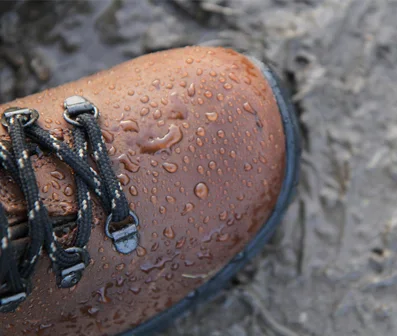
Down can be treated with a Durable Water Repellent (DWR) treatment to make it more hydrophobic.
The International Down and Feather Bureau has established several laboratory methods to evaluate these treatments, including a hydrophobic shake test, water absorption, drying time and durability of the treatment after laundering.
So hydrophobic down is not purely a marketing invention. Its water behaviour can be tested.
But its significance for an entire sleeping bag requires more caution.
A DWR treatment does not make down waterproof, and it certainly does not make the sleeping bag waterproof. Even manufacturers using hydrophobic down acknowledge that distinction.
For sleeping bags, I would therefore consider hydrophobic down a secondary, situation-dependent feature.
It may be particularly interesting during multi-day use in persistently humid conditions, cold-weather trips where condensation gradually accumulates in the insulation, bivouacking or expeditions where thoroughly drying a bag is difficult.
For normal three-season use where a sleeping bag is protected from rain and regularly aired, fill weight, construction, fit, shell design and tested temperature performance are likely to be more important selection criteria.
There is another reason for caution: the IDFB methods allow treated and untreated loose down to be compared under standard conditions, but that does not automatically quantify the real-world thermal benefit inside a complete sleeping bag over days of use.
A useful question is therefore not simply:
“Does it contain hydrophobic down?”
but:
“According to which test was the treatment evaluated, and how durable is the effect after use and washing?”
Washing a down sleeping bag
A down sleeping bag can be washed.
The technically difficult part is often not getting it wet. It is getting a large quantity of wet, clumped down completely dry and fully lofted again.
When down becomes wet, the clusters stick together. The sleeping bag can look alarmingly flat after washing. This does not necessarily mean the down has been damaged.
French sleeping-bag maker Valandré explicitly describes this clumping as normal. It recommends tumble drying at low temperature, stopping periodically to break apart clusters by hand, and repeating the drying cycle as necessary.
Specialist cleaner Scottish Mountain Gear uses industrial washers and dryers with large-diameter drums, specifically because down-filled sleeping bags need room to move while being gently washed and dried without overloading their internal baffles. 16
This suggests a useful practical rule:
For a heavily filled sleeping bag, adequate dryer volume, low heat, patience and complete de-clumping are at least as important as the washing stage itself.
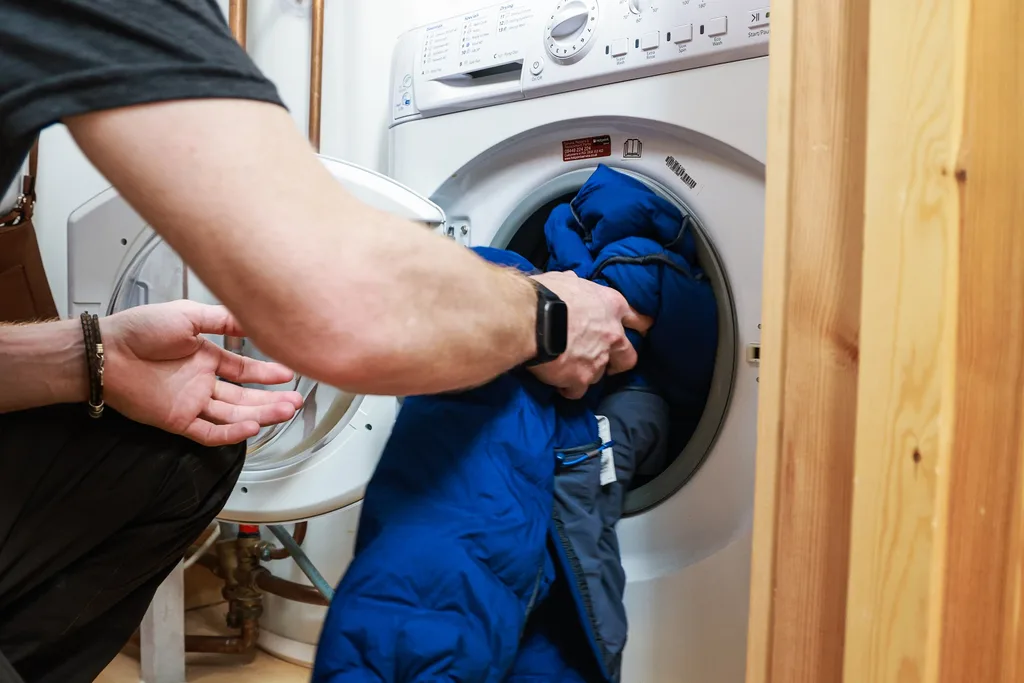
A small domestic tumble dryer may simply be unsuitable for a large winter bag.
Dryer balls and the tennis-ball advice
A common piece of advice is to add tennis balls when washing down. The useful part of that advice concerns drying rather than washing.
When down is wet, clusters stick together. Mechanical movement in a tumble dryer can help separate those clusters and restore loft. Grangers therefore supplies three purpose-made reusable dryer balls with its down-care kits and instructs users to add them during the drying cycle. Grangers
Grangers specifically advises against ordinary tennis balls, arguing that they may leak colour and strike the down too aggressively. Its own dryer balls are designed to separate clumps more gently. Grangers
The balls themselves are not the crucial part of the process. What matters most is that the item has enough room to tumble, is dried at an appropriate low temperature, is checked periodically, and is not removed until the down is completely dry and evenly lofted. Grangers itself emphasises periodic checking and complete drying.
Do you need a special down detergent?
Specialist down detergents exist and can be a safe choice.
What we have not found is good evidence demonstrating that a product marketed specifically as “down wash” is inherently necessary or superior to every suitable mild detergent.
Valandré, a specialist European down sleeping-bag manufacturer, explicitly advises that its products can be washed using a mild liquid detergent and states that the owner’s usual mild detergent is acceptable. 17
Other manufacturers recommend dedicated down detergents. That difference in recommendations is itself a reason not to turn one manufacturer’s care instruction into a universal scientific rule.
The care label of the actual sleeping bag should therefore remain the starting point. Bleach and fabric softeners should be avoided where prohibited, detergent should not be overdosed, and thorough rinsing matters.
It is reasonable to choose a specialist down detergent because it reduces uncertainty.
It is not justified to state as fact that only a specialist down detergent can safely clean down.
Field experience: washing old down
In my own experience over several decades, I have successfully washed down sleeping bags — including bags around forty years old — using mild cleaning products rather than relying exclusively on products sold specifically as down wash.
Some of those sleeping bags are still usable today.
That is field experience, not a controlled comparison of detergents. It cannot demonstrate that every mild detergent is safe for every down treatment, fabric or sleeping bag.
But it is one more reason to be cautious about presenting “special down wash is essential” as an established technical fact.
Should you wash it yourself or use a specialist?
For many sleeping bags, careful home washing is perfectly possible if the manufacturer permits it and sufficiently large washing and drying machines are available.
The larger and heavier the bag, the more attractive specialist cleaning becomes.
Wet down is heavy, and a saturated sleeping bag needs to be handled carefully so that baffles and seams are not subjected to excessive loads. Heavily insulated winter bags can also be difficult to tumble freely in domestic machines.
Professional down cleaning can go considerably further than putting the entire sleeping bag in a large washer.
Scottish Mountain Gear describes a specialist process for heavily soiled expedition equipment in which the sleeping bag or garment is opened, all the down is removed, the empty shell is washed separately, the down itself is cleaned separately, and the product is then refilled.
This is not necessary for routine cleaning, but it demonstrates an important characteristic of down equipment: the filling can exist independently of the original sleeping-bag shell.
Down sleeping bags can be refilled
This may be one of the most underappreciated differences between down and most synthetic sleeping bags.
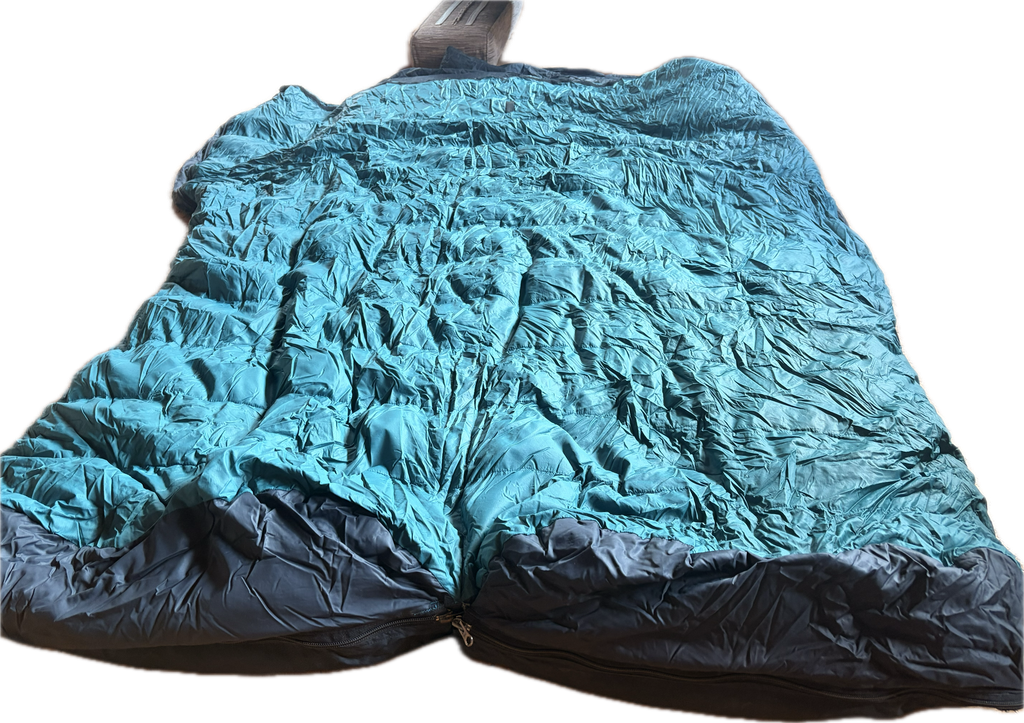
Down is a loose filling material contained within chambers. A skilled repairer can open a chamber, add down and close it again. Down can also be redistributed, partially replaced or recovered during more extensive restoration.
Specialist services do this in practice. Scottish Mountain Gear offers replacement and topping-up of down in sleeping bags and clothing. Nordisk repairs and refills down sleeping bags at its Care & Repair centre in Görlitz, Germany. Valandré also offers washing, repair and additional filling of its sleeping bags.
Tatteljee went even further. Its archived service information describes replacing an old worn shell and filling the new shell with down recovered from the old sleeping bag, supplemented with new down where necessary.
Field experience: refillability
In my years working with sleeping bags I sold hundreds of different down sleeping-bag models. Of all those models, I encountered only one that could not be topped up in the normal way; because of its particular construction it had to be sent to a specialist down filler in Berlin.
My practical experience is therefore that almost every conventionally constructed down sleeping bag can technically be refilled, even when the original manufacturer does not offer such a service.
That should be distinguished from a universal technical claim: unusual constructions exist and access to the chambers can make the work more or less difficult.
But in practice, refillability is normal for down sleeping bags rather than exceptional.
For synthetic insulation the opposite is true. Shells and zips can be repaired, but replacement or topping-up of the actual insulation is extremely rare.
That difference deserves much more attention when discussing product longevity.
Storage and long-term care
Down should be allowed to recover its full volume between trips.
A compression sack is a transport tool, not an ideal long-term storage system. Nordisk, for example, advises storing sleeping bags uncompressed and notes that prolonged compression can reduce elasticity and loft.
After a trip, a sleeping bag should be dried and aired before storage. Washing every time is neither necessary nor desirable, but dirt and body oils should not simply accumulate indefinitely.
A liner can reduce contamination of the sleeping bag itself, but it does not remove the need for occasional cleaning.
Above all, a down sleeping bag should not be discarded simply because it no longer performs exactly as it did when new.
Cleaning, redistributing the down, repairing the shell or baffles and adding new down can sometimes restore a surprisingly old product.
So what should we actually look for?
An impressive fill-power number is useful information, but it is only one part of the picture.
For a down sleeping bag, a meaningful assessment combines fill power and its test method with the actual fill weight, down/feather composition, temperature rating of the finished sleeping bag, construction and fit, origin and traceability of the filling, animal-welfare controls, moisture strategy and possibilities for future repair and refill.
For a down jacket, fill weight deserves far more attention than it generally receives. Without it, comparing two fill-power numbers can be misleading.
For ethical sourcing, RDS or DOWNPASS can provide considerably more confidence than an unsupported statement such as “responsibly sourced down”, but neither label is a temperature rating or guarantee of exceptionally high fill power.
And when the geographical origin of the down is not disclosed, we should resist filling the information gap ourselves.
We simply do not know.
What remains true?
Down deserves its reputation as an extraordinarily efficient insulation material, particularly when low weight and small pack volume matter.
But its greatest advantage may not be captured by a specification sheet at all.
Good down can remain functional for decades. It can be washed. It can recover loft. It can be moved between chambers. More can be added. In some cases it can even be removed from a worn-out sleeping bag, cleaned and given a second life inside a new shell.
Its weaknesses are equally real. Saturated down loses loft. Drying it properly takes care and time. Animal origin creates legitimate welfare and traceability questions. And the apparently precise fill-power number on the label depends on a test method whose history is much more complicated than the number suggests.
That makes a simple hierarchy impossible.
Goose is not automatically better than duck. Chinese down is not automatically worse than European down. Hydrophobic down is not waterproof. Synthetic insulation is not one single material. RDS-certified down is not necessarily high-fill-power down. A specialist down detergent is not proven to be essential. And a sleeping bag advertised with 1,000 fill power is not necessarily warmer than one marked 700.
Perhaps the most useful question is therefore not:
“What is the fill power?”
but:
“What exactly does this specification tell me — and what does it not tell me?”
Kristjánsson, T.Ö. & Jónsson, J.E. (2011). Effects of down collection on incubation temperature, nesting behaviour and hatching success of common eiders (Somateria mollissima) in west Iceland. Polar Biology 34, 985–994. DOI 10.1007/s00300-010-0956-z. ↩︎
An, Y., Xu, G. & Shen, H. (2021). Factors influencing thermal resistance of a down sleeping bag. International Journal of Clothing Science and Technology, 33(6), 966–979. DOI 10.1108/IJCST-05-2020-0071. ↩︎
International Organization for Standardization. ISO 23537-1:2022 — Requirements for sleeping bags — Part 1: Thermal, mass and dimensional requirements for sleeping bags designed for limit temperatures of −20 °C and higher. ↩︎
International Down and Feather Bureau (IDFB). IDFB Testing Regulations, version June 2024; Part 10-B, Volume Measurement — Fill Power with Steam Conditioning, version June 2023; and Part 18, Evaluation of Durable Water Repellent Treatments. The regulations specify current 30 g fill-power testing, the historical relationship with the old US one-ounce cylinder, conditioning and DWR test methods. ↩︎
IDFL Laboratory and Institute. New EN Fill Power Standard, 2019. Summary of the transition from EN 12130:1998 to EN 12130:2018, including the move from 20 g to 30 g and the three conditioning routes. ↩︎
Tatteljee archive. Repair & Maintenance. Historical maker documentation concerning refill, cleaning, re-use of existing down in a replacement shell and historic European/US fill-power comparisons. ↩︎
Dąbrowska, A.K., Bartkowiak, G., Karcz, J. & Frydrych, I. (2017). Assessment of the non-woven, goose down and duck down as thermally insulating materials for the clothing protecting against cold. International Journal of Clothing Science and Technology, 29(3), 380–393. DOI 10.1108/IJCST-08-2016-0094. ↩︎
Kim, S., Kim, E. & Park, Y. (2018). Thermal insulation and morphology of natural and synthetic filled outdoor sportswear by repeated water washing and dry cleaning. International Journal of Clothing Science and Technology, 30(3), 428–443. DOI 10.1108/IJCST-09-2017-0149. ↩︎
State Administration for Market Regulation / Standardization Administration of China. GB/T 10288-2026 — Test method for down and feather, implemented 1 September 2026; and GB/T 14272-2021 — Down garments. ↩︎
European Commission and European Union. Regulation (EU) No 1007/2011 and Commission guidance on textile labelling. The Regulation covers fibre composition and animal-origin components within scope but does not cover country-of-origin labelling. ↩︎
EFSA Panel on Animal Health and Welfare (2010). Scientific Opinion on the practice of harvesting (collecting) feathers from live geese for down production. EFSA Journal 8(11):1886. DOI 10.2903/j.efsa.2010.1886. ↩︎
Food and Agriculture Organization of the United Nations. Goose Production, Chapter 10: Feather and Down Production. Historical description of slaughter harvesting and repeated collection from live geese. ↩︎
Textile Exchange. Responsible Down Standard (RDS). Current explanation of animal-welfare requirements, prohibition of live removal and force-feeding, certification and chain of custody. ↩︎
DOWNPASS. Animal Welfare & Quality. Current description of the zero-tolerance standard, independent auditing and product-quality verification. ↩︎
Bakken, G.S., Banta, M.R., Higginbotham, C.M. & Lynott, A.J. (2006). It’s just ducky to be clean: the water repellency and water penetration resistance of swimming mallard Anas platyrhynchos ducklings. Journal of Avian Biology, 37, 561–571. DOI 10.1111/j.0908-8857.2006.03685.x. ↩︎
Scottish Mountain Gear. Down Filled Product Cleaning and Down Refilling. Specialist guidance describing large-diameter industrial drums, refill services and, for heavily soiled expedition gear, removal and separate cleaning of the down and shell. ↩︎
Valandré. Product Care. Manufacturer care guidance permitting mild liquid detergent and emphasising tumble drying, repeated cycles and manual separation of wet down clusters. ↩︎