Understanding headlamp light
What determines how well you see with a headlamp
A headlamp can produce a great deal of light and still make the trail difficult to read. Another may have a lower maximum output yet place more useful light on the ground, maintain it for longer, or make important colour differences easier to judge.
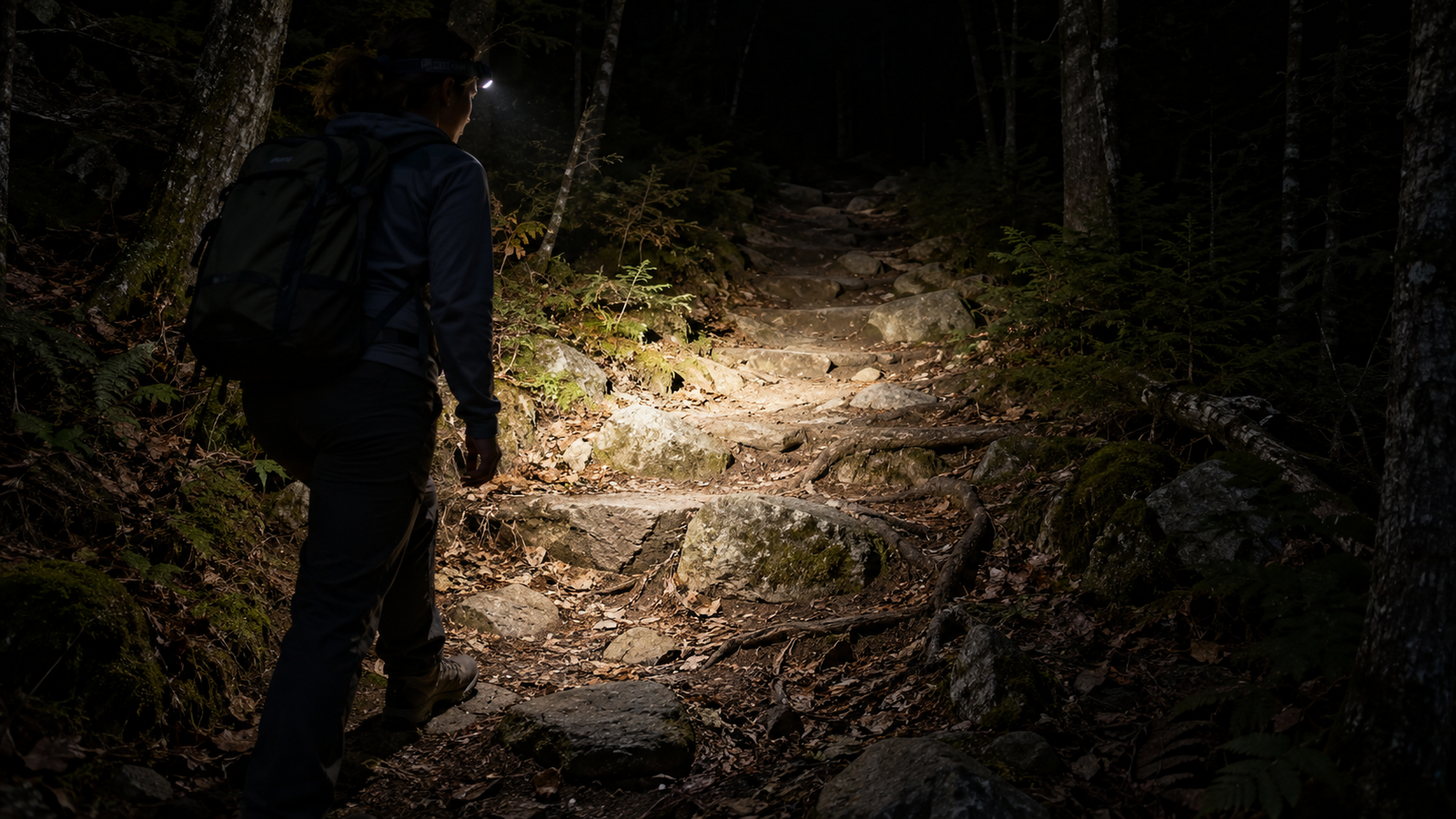
Lumens tell us how much visible light a lamp emits. They do not tell us where it goes, how objects look under it, or how the output changes during a night outdoors. To understand those differences, we need to follow the light from the lamp, through its optics and the air, onto the terrain and back to our eyes.
This dossier explains the main quantities behind that journey and how to interpret them when walking, running or camping. It also considers what an interactive image can illustrate, and what requires measurements or real outdoor observation. The aim is to help you ask better questions about a headlamp rather than identify one universally best specification.
Light output and where it goes
Luminous flux, measured in lumens, describes the total light emitted, weighted using a standard model of human visual sensitivity. It is a useful basis for comparison. But the same lumen output can be distributed in very different ways.
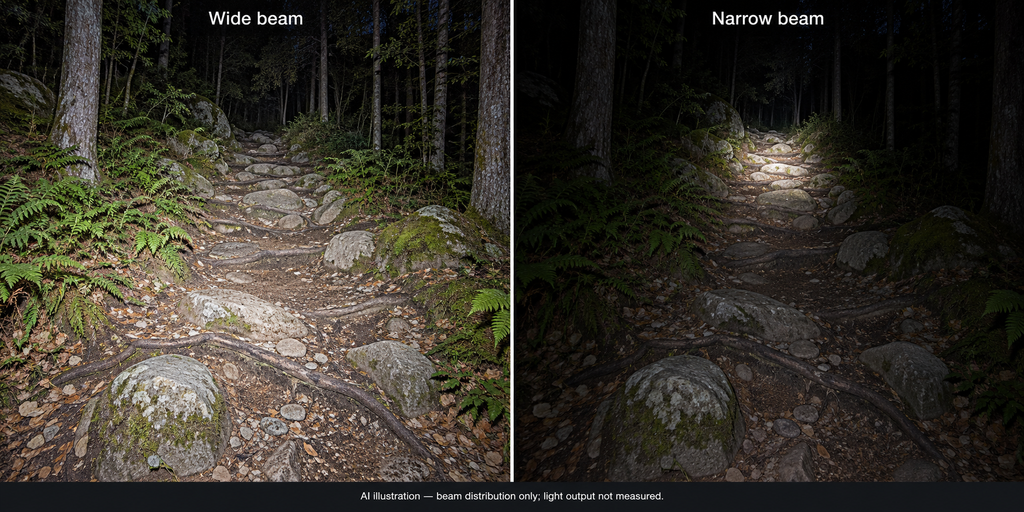
Imagine two lamps producing 500 lumens. One spreads the light across the path and its edges. The other concentrates much of it into a small central spot. The broad beam may make nearby footing easier to inspect; the concentrated beam may make a distant feature more conspicuous. Neither distribution is inherently better. Their usefulness depends on the task.
Three quantities help separate these effects. Lumens describe total luminous flux. Candela describes luminous intensity in a particular direction. Lux describes the luminous flux arriving per unit area of a surface: one lumen per square metre. A lumen figure alone cannot tell you the illuminance on a rock several metres ahead.
For a walker, a broad, reasonably even beam can make it easier to scan the next steps without constantly moving the head. A focused component can help when searching for a route marker or checking where a path continues. A mixed beam combines these functions, although the balance between the central spot and surrounding light matters as much as the label.
Look at the transition between bright and dark areas as well as the width. An intense central spot can dominate the view while leaving the edges comparatively dark. Conversely, a very wide distribution may provide too little illumination where you need to look further ahead. Useful beam shape is a relationship between coverage, intensity and the scene.
Manufacturer data can illustrate this without proving overall field performance. Lagolight lists the IXO2.1 focused mode at 270 lumens and more than 110 metres, while its broad mode is listed at 280 lumens and more than 45 metres. The slightly higher lumen figure does not produce the greater quoted reach. These are manufacturer specifications for one model, not independent InEurope measurements.1
What a quoted beam distance means
A distance printed on a box needs a measurement definition. In Petzl’s explanation of the ANSI/PLATO FL1 protocol, 2beam distance is the distance at which illuminance falls to 0.25 lux. It is a defined threshold, not a demonstration that you can confidently recognise every obstacle at that distance.
A pale sign, a dark root and a wet rock do not return light in the same way. Their size, contrast and surroundings also affect what you can distinguish. A quoted reach of 100 metres therefore should not be read as 100 metres of clear trail detail.
When comparing lamps, check whether distances use the same method and operating mode. Keep the distinction between a measured lighting quantity and a human task: detecting that something is present, identifying it, and choosing a foot placement are different demands.
Colour temperature and colour rendering
White light can look warm and yellowish, relatively neutral, or cool and bluish. Correlated colour temperature, usually shortened to CCT, describes this aspect of its appearance and is expressed in kelvin. Around 3000 K is commonly described as warm white, around 4000 K as neutral white, and around 6000 K as cool white. These descriptions are approximate, and perceived appearance also depends on adaptation and surroundings. 3
CCT is not a brightness rating or a complete description of a lamp’s spectrum. Two sources with the same CCT can distribute their energy differently across wavelengths and make coloured objects look different. A warmer appearance is not, by itself, proof of better visibility.
Colour rendering concerns how a source renders object colours relative to a reference. The familiar general Colour Rendering Index, Ra, summarises results for eight test colours. Additional indices describe other test colours, including a saturated red. Consequently, the general CRI value does not fully describe every colour difference that might matter outdoors. 4
A high CRI can be relevant when colour fidelity matters, such as comparing coloured equipment or reading map symbols. It should not be treated as a direct score for recognising roots, estimating depth or moving safely. Those tasks also depend on illumination, shadows, contrast, viewing conditions and the observer.
This distinction matters when comparing a modest-output lamp with good colour rendering and a more powerful lamp with a lower CRI. Neither specification settles the choice. Ask whether there is enough useful illumination, whether the beam suits the task, and whether colour fidelity is important for what you need to recognise.
If a manufacturer does not publish CCT or CRI, record that information as unknown. Do not infer it from a promotional photograph: camera settings and image processing can change the appearance substantially.
STOOTS and the choices behind the light
STOOTS, already featured by InEurope, offers a concrete example of these design decisions. Its technology page describes choosing 4000 K LEDs with a CRI of 80 to balance efficiency and a pleasant light. These are the manufacturer’s stated choices, not evidence that this combination is ideal for every user or condition. 5
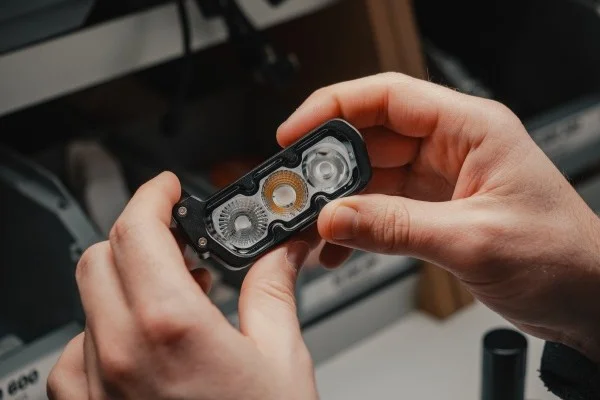
The same explanation connects LED selection with optics. For its spot beam, STOOTS says it favours a smaller emitting source over maximum LED efficacy to obtain a tighter beam. The example shows why a component cannot be judged by its lumen-per-watt figure alone: the designer also needs to put the light where it will be useful.
For the reader, this makes the specification a starting point for understanding an engineering decision. Colour appearance, colour fidelity, beam distribution and energy use need to be considered together.
Explore the scene
The accompanying Light Explorer offers three settings each for light output, colour temperature, colour rendering and beam width. Use the rocky trail scene to explore these ideas one at a time. Keep the other controls unchanged while comparing a wide beam with a spot, then a warmer with a cooler appearance.
LIGHT EXPLORER
See your trail in a different light.
Choose one of three settings in each group and compare the effect on the scene.
Place the photo named trail-night.png in the same folder as this HTML file, then reopen this page.

Brightness (lumens)
More lumens increase the total amount of light. How useful that light is also depends on how the beam is distributed.
Colour temperature (Kelvin)
4000 K gives a relatively neutral light.
Colour rendering (CRI)
CRI 80 gives reasonably natural colour rendering.
Beam pattern
A medium beam balances nearby visibility and distance.
Start with the shape of the illuminated area. Notice how your attention moves between the centre of the path and its edges. Next change the apparent light level. Finally compare colour appearance, looking at the painted trail marker, vegetation and stone. The exercise is to notice different visual effects, not to choose a winning combination of numbers.
The controls apply illustrative screen effects to a single image. Their lumen and kelvin labels are not calibrated reproductions of those lamp outputs. The beam control changes an overlay’s width; it does not model redistribution of a fixed luminous flux. The CRI control changes saturation and contrast, which cannot reproduce the colour rendering of a measured light source.
The original lighting and shadows remain part of the image, and some adjustments also affect the background. Your display and viewing environment add further differences. Use the explorer to understand why several properties deserve attention, not to predict visibility, compare products, or calculate how much light a route requires.
Terrain and weather change the task
The light arriving on a surface is only part of what you see. The surface determines what is reflected towards your eyes. Shape, texture, colour, wetness and viewing angle influence the result. Reading terrain therefore involves more than making the scene brighter.
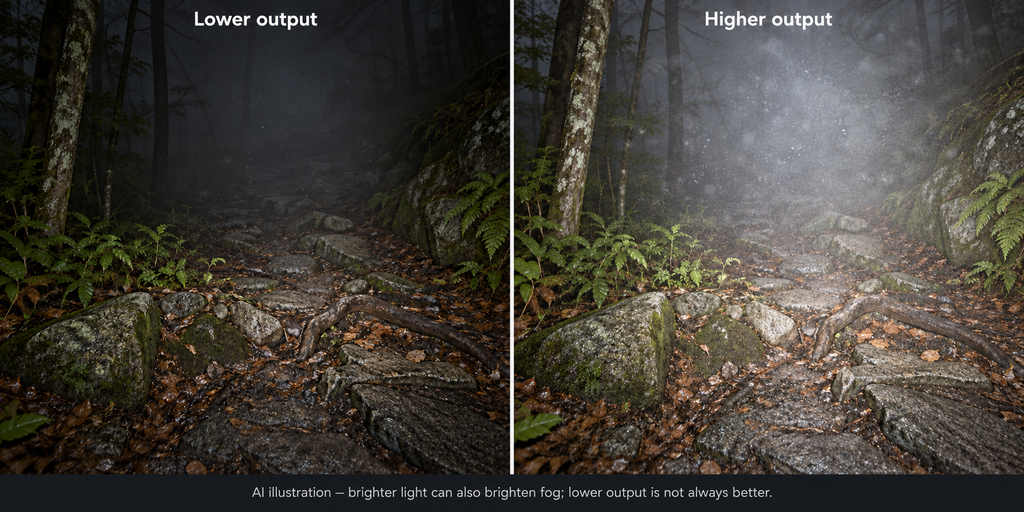
In clear conditions, changing the output and beam direction can help you find a useful balance between nearby detail and a view ahead. In mist, rain or falling snow, light can also return from droplets or flakes between the lamp and the terrain. Because a headlamp sits close to your line of sight, illuminated particles can occupy a prominent part of the view.
More output may brighten both the intended target and the intervening air. Turning the lamp down can sometimes reduce distraction or discomfort, but it does not guarantee better visibility: it also reduces illumination of the terrain. Try settings against the feature you actually need to see rather than assume either maximum or minimum output is best.
Wet surfaces can produce bright reflections and change the contrast between neighbouring areas. Falling snow adds moving bright points, while snow already on the ground changes the scene’s reflectance. These situations favour attentive adjustment over a fixed rule about lumens.
Colour temperature is sometimes presented as the solution to poor-weather visibility. Research offers a more conditional picture. Kang and Kwon compared automotive lighting at 3000 K and 6000 K under different weather and target conditions. Their measurements showed that the contrast differences varied with the test situation. The work does not establish one colour temperature as best for every outdoor use. 6
Car headlights and road lighting also differ from a head-mounted lamp in position, geometry and viewing conditions. Such research helps explain why spectrum and conditions deserve study; it does not directly validate a preferred hiking setting. The Light Explorer cannot settle this question either, since it contains no measured fog or scattering model.
Maximum output describes only one part of a lamp’s behaviour. For a long walk, a more useful question is how the output changes over the hours you expect to use it. A brief high setting, a gradual decline and a prolonged stable level can produce very different experiences.
Do not combine the largest lumen figure and the longest runtime on a product page unless they explicitly describe the same mode. Even when they do, a runtime figure need not mean that the starting output is maintained throughout.
Petzl’s FL1 explanation describes runtime as the interval from 30 seconds after switch-on until output falls to 10% of its initial maximum. This allows substantial dimming within the quoted runtime. A graph of output against time is therefore more informative than a duration alone.
Standards also evolve. PLATO announced the FL1-2025 revision in February 2026, including a defined method for short-duration elevated brightness, commonly called turbo or boost. Check which version and test method underlie a claim rather than assume every published figure was obtained in the same way. 7
Regulation describes how the lamp controls output as conditions change. Ask how long a useful level is sustained, what happens near battery depletion, and whether a higher setting is limited in duration. A published curve should identify the tested mode and conditions; an unexplained graph can be as ambiguous as a single number.
Battery energy is most directly compared in watt-hours. Milliamp-hours alone omit voltage. For example, the IXO2.1’s listed 3.7 V and 3500 mAh correspond to approximately 13 Wh of nominal battery energy. That calculation does not determine runtime by itself: power consumption and usable battery energy still matter.
Likewise, an LED component’s lumens-per-watt figure is not automatically the efficiency of the complete lamp. Electronics, optics and operating conditions affect the final result. Comparing headline component values without those conditions can create a misleading impression of which lamp uses energy more effectively.
When reading a test, check what was measured. A lux meter at a fixed point can track changes in illumination over time, provided the setup stays controlled. That is useful information about stability at that point, but it is not automatically a measurement of the lamp’s total luminous flux.
Match the light to the activity
There is no single lumen recommendation that covers a slow walk, a fast descent and reading inside a tent. The relevant question is how much useful information the light provides, over the time and area you need it.
- Walking and trekking — prioritise readable ground ahead, sufficient awareness at the edges of the path and a useful level that lasts. Additional reach can help when checking route features.
- Running and orienteering — consider both foot placement and the view further ahead. A mixed distribution or a separate focused mode may help, but a high maximum output does not establish the quality of either.
- Camp and close work — look for a genuinely low usable setting, comfortable nearby illumination and control over light directed towards other people. Maximum reach is less important here.
- Underground spaces — nearby coverage and the ability to inspect distant features may both matter. Lighting quality is only part of the equipment and planning requirements; this dossier is not a caving equipment guide.
These are starting points for assessment rather than universal prescriptions. The same activity can involve different terrain, speeds and visual demands. If you can try a lamp, compare modes on a representative scene and look at the areas you need to interpret, not only the brightest patch.
Useful light over time
Maximum output describes only one part of a lamp’s behaviour. For a long walk, a more useful question is how the output changes over the hours you expect to use it. A brief high setting, a gradual decline and a prolonged stable level can produce very different experiences.
Do not combine the largest lumen figure and the longest runtime on a product page unless they explicitly describe the same mode. Even when they do, a runtime figure need not mean that the starting output is maintained throughout.
Petzl’s FL1 explanation describes runtime as the interval from 30 seconds after switch-on until output falls to 10% of its initial maximum. This allows substantial dimming within the quoted runtime. A graph of output against time is therefore more informative than a duration alone. [2]
Standards also evolve. PLATO announced the FL1-2025 revision in February 2026, including a defined method for short-duration elevated brightness, commonly called turbo or boost. Check which version and test method underlie a claim rather than assume every published figure was obtained in the same way. [6]
Regulation describes how the lamp controls output as conditions change. Ask how long a useful level is sustained, what happens near battery depletion, and whether a higher setting is limited in duration. A published curve should identify the tested mode and conditions; an unexplained graph can be as ambiguous as a single number.
Battery energy is most directly compared in watt-hours. Milliamp-hours alone omit voltage. For example, the IXO2.1’s listed 3.7 V and 3500 mAh correspond to approximately 13 Wh of nominal battery energy. That calculation does not determine runtime by itself: power consumption and usable battery energy still matter. [1]
Likewise, an LED component’s lumens-per-watt figure is not automatically the efficiency of the complete lamp. Electronics, optics and operating conditions affect the final result. Comparing headline component values without those conditions can create a misleading impression of which lamp uses energy more effectively.
When reading a test, check what was measured. A lux meter at a fixed point can track changes in illumination over time, provided the setup stays controlled. That is useful information about stability at that point, but it is not automatically a measurement of the lamp’s total luminous flux.
Compare specifications with better questions
A useful comparison links each specification to a decision. Start with your activity, then ask the following questions of both lamps.
- Where does the light go? Look for comparable beam images or descriptions of broad, focused and mixed modes.
- What does the quoted reach measure? Check the threshold, method and mode, and separate that figure from the distance at which you can judge terrain.
- How does output change over time? Prefer a documented curve or sustained-output information to unrelated maximum and runtime figures.
- What is known about colour? Treat CCT and CRI as different characteristics, and keep missing information visible.
- What must you carry? Compare weight including the battery, available energy, and the practical arrangements for charging or replacing it.
- What supports the claims? Distinguish a manufacturer specification from an independent measurement or an observation in the field.
A credible comparison may leave some cells blank. That is preferable to filling them with estimates from photographs, assumptions about LED types or numbers copied without their conditions.
Connecting knowledge with European makers
These lighting principles apply regardless of where a lamp is manufactured. Within InEurope, they can help explain the choices made by European producers and guide questions about their optics, electronics, repair options and testing. The technical explanation should remain understandable without those examples.
STOOTS and Lagolight provide two complementary examples in this dossier. Lagolight’s mode specifications make the relationship between output and reach tangible. STOOTS’ technical explanation reveals how colour and the LED–optic combination enter the design process. Both help connect the underlying knowledge with identifiable makers, without determining the general conclusions.
For more about the maker already covered by InEurope, read STOOTS — High-Performance Headlamps from France. The profile provides a route into the company’s story; the technical claims here refer to the manufacturer’s documentation and the scientific sources listed below.
These examples are a selection, not a complete inventory of European headlamp manufacturers. Production location does not establish lighting quality. Claims about manufacturing location need their own evidence and must distinguish final assembly from component origins.
For InEurope, Made in Europe refers to final manufacturing or assembly in geographical Europe within the project’s defined scope. It does not mean that all materials and components originate there, and it is not presented as a universal legal origin rule. Technical merit and production location are separate questions. 8
Choosing useful light
Lumens remain useful. Their limitation is that they describe total output while seeing outdoors depends on what happens to that light afterwards. Beam distribution determines where it is directed; the scene and atmosphere influence what returns; colour characteristics affect appearance; and the lamp’s behaviour over time determines how long those conditions last.
Choose by the task in front of you. Look for enough usable illumination, a suitable distribution and documented performance over the required duration. Use colour specifications to add understanding, and treat demonstrations and photographs as illustrations with limits. A good headlamp comparison explains those relationships instead of asking one large number to stand for all of them.
Sources and evidence limits
The numbered references distinguish manufacturer information, measurement guidance, colour science, original research and InEurope policy. No independent headlamp measurements are reported in this dossier. The interactive scene is an illustration, not experimental evidence.
Lagolight. LAGO IXO2.1 product specifications. Manufacturer source for the quoted beam, output and battery data. Product information can change. ↩︎
Petzl. How is lighting performance measured with the ANSI PLATO FL1 protocol. Manufacturer explanation of measurement conventions. It is not the complete standard or proof of sustained output for a particular lamp. ↩︎
CIE. Terms related to Planckian radiation temperature for light sources. CIE TN 013:2022. Authoritative terminology for colour temperature and related quantities. ↩︎
CIE. Method of measuring and specifying colour rendering properties of light sources. CIE 13.3:1995. Basis of the general and special colour rendering indices; not a test of outdoor task performance. ↩︎
STOOTS. Technologies. Consulted 8 October 2026. Manufacturer explanation of colour and LED choices. The page also contains older model specifications with different colour temperatures; check the exact model and generation rather than generalising these values to every STOOTS lamp. ↩︎
Kang H J and Kwon S J. A Study on the Night Visibility Evaluation Method of Color Temperature Convertible Automotive Headlamps Considering Weather Conditions. Applied Sciences 2021, 11(18), 8661. Original automotive contrast measurements; transfer to head-mounted outdoor lighting is limited. ↩︎
PLATO. Publication of revised ANSI PLATO FL1 2025 standard. Announcement dated 3 February 2026. Supports the existence and stated scope of the update, not unreported test details. ↩︎
InEurope Masterplan 1-0, Scope and Verification Method, last change 25 August 2026. Internal policy source for InEurope’s production scope; not evidence for any particular manufacturer’s origin. ↩︎